RYA Day Skipper Theory: The COLREGS You'll Actually Be Tested On
Which COLREGS rules dominate the Day Skipper theory exam, the traps that catch candidates out, and a practical 4-week prep plan.
31 August 2026 · 8 min read · IRPCS crew
The RYA Day Skipper theory course covers a lot of ground. Tidal calculations, chartwork, meteorology all compete for study time, but for many candidates the COLREGS section feels the most daunting. The rules are precise, the language is deliberate, and a small misreading can flip a correct answer into a wrong one. The good news is that the syllabus does not demand equal fluency across all 41 rules. A focused cluster of rules and annexes accounts for the overwhelming majority of exam questions, and once you understand what the examiners are actually probing, the marks become very achievable.
This guide identifies those high-priority rules, explains the traps that trip up candidates year after year, and gives you a four-week study plan that fits around a working week. It is educational support, not a substitute for your course instructor or the official RYA publications, but used alongside those resources it should sharpen your preparation considerably.
The Rules That Dominate the Syllabus
Day Skipper theory is aimed at skippers operating in coastal and inshore waters, so the examiners weight their questions accordingly. You will not be heavily tested on rules that apply exclusively to deep-sea vessels in traffic separation schemes, but you absolutely will be tested on lights, shapes, sound signals, and the fundamental collision-avoidance hierarchy.
Rules 5, 7, 8 and 16 - the decision chain. Rule 5 requires every vessel to maintain a proper lookout at all times. Rule 7 covers how to determine whether a risk of collision exists (compass bearings that do not appreciably change are the classic indicator). Rule 8 sets out what action to avoid a collision must look like: positive, made in ample time, and large enough to be readily apparent to another vessel. Rule 16 then places the responsibility on the give-way vessel to take early and substantial action. Exam questions often present a scenario and ask whether the skipper has complied with one of these rules; reading carefully to identify which rule is being tested is half the battle.
Rules 13, 14 and 15 - the three encounter types. Overtaking, head-on, and crossing situations each have their own rule, and the examiners love to construct scenarios that look like one but are actually another. The critical point under Rule 13 is that an overtaking vessel remains burdened until it is finally past and clear, regardless of any subsequent change in relative bearing. Under Rule 14 a head-on situation is assumed to exist whenever there is any doubt. Rule 15 creates the crossing hierarchy: the vessel that has the other on its starboard side gives way.
Rule 18 - the pecking order. The responsibility between vessels rule establishes the broad hierarchy: power-driven vessels manoeuvre for sailing vessels, sailing vessels manoeuvre for vessels not under command or restricted in their ability to manoeuvre, and so on. A common candidate error is forgetting that a vessel using her engine for propulsion is defined under Rule 3 as a power-driven vessel, even with sails set. The consequences of that definition flow through Rule 18 and into the shapes requirement under Rule 25.
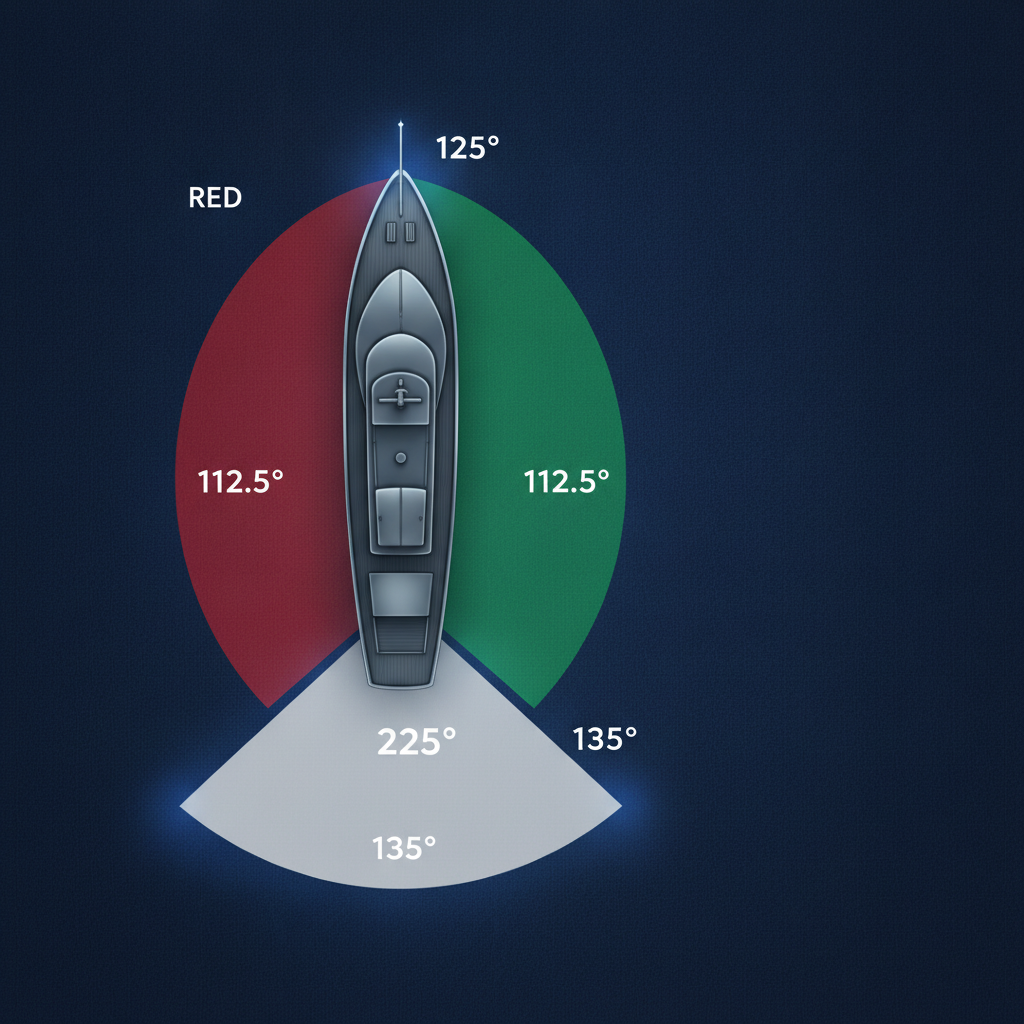
Navigation lights - Rules 20 to 31 and Annex I. Light questions are a staple of the exam. You need to be able to identify the lights displayed by a power-driven vessel underway, a vessel at anchor, a vessel aground, a sailing vessel under sail alone, and a pilot vessel. The arcs matter just as much as the colours: sidelights cover 112.5 degrees each, a sternlight covers 135 degrees, and a masthead steaming light covers 225 degrees. Annex I contains the technical specifications for those arcs, and examiners do ask about them.
Sound signals - Rules 34 and 35. Rule 34 covers manoeuvring and warning signals when vessels are in sight of one another; Rule 35 covers signals in restricted visibility. The one-short-blast and two-short-blast system for indicating alteration of course is tested regularly, as is the five-or-more short blasts danger signal. A common trap is that Rule 35 signals are based on vessel type and status, not on what the other vessel is doing. Candidates sometimes confuse the two rules and try to apply manoeuvring signals in fog.
Rule 19 - restricted visibility. Almost every coastal skipper will encounter fog, so this rule gets exam attention. Rule 19 requires vessels to proceed at a safe speed adapted to the prevailing conditions and to have engines ready for immediate manoeuvre. A key restriction sits in Rule 19(d): a vessel that has detected another vessel by radar alone must avoid altering course to port for a vessel forward of the beam (other than in an overtaking situation) and must avoid altering course towards a vessel abeam or abaft the beam. Separately, Rule 19(e) addresses what to do on hearing a fog signal forward of the beam - the required response is to reduce to the minimum speed at which the vessel can be kept on course. These two provisions are distinct, and conflating them is a reliable way to lose marks.
Common Exam Traps
Beyond the individual rules, a handful of conceptual traps catch candidates repeatedly.
The sailing vessel trap. As noted above, a vessel propelled by machinery is a power-driven vessel under Rule 3, regardless of whether sails are also set. Rule 25(e) requires such a vessel, when proceeding under sail while also being propelled by machinery, to exhibit a cone shape apex downwards in the fore part of the vessel by day. Get that wrong in the exam and you lose marks on both the definition question and any related shapes question.
Sectors versus arcs. Exam diagrams sometimes show a vessel at an oblique angle and ask which lights would be visible. Work methodically from the vessel's centreline rather than from your position on the page. Sketch the arcs on rough paper before committing to an answer.
Give-way versus stand-on confusion in Rule 17. Rule 17 allows the stand-on vessel to take action to avoid collision once it becomes apparent that the give-way vessel is not acting correctly, but that permission does not become an obligation until danger is imminent. Candidates sometimes state that the stand-on vessel must act immediately, which overstates the rule.
The overtaking definition boundary. Rule 13 defines an overtaking vessel as one approaching from a direction more than 22.5 degrees abaft the other vessel's beam. That figure mirrors the arc of the sternlight. If you can see only the sternlight of the vessel ahead, you are overtaking. Linking the definition to the sternlight arc makes the number far easier to retain under pressure.
For a searchable breakdown of every rule referenced here, the IRPCS rule library at /#learn is worth bookmarking for study sessions.
A 4-Week Prep Plan
This plan assumes roughly four to five hours of study per week, which is realistic for someone balancing a job or family commitments.
Week 1 - Foundation rules. Focus on Rules 1 to 10. Read each rule summary, then write out in your own words what it requires. Pay particular attention to Rules 5, 7 and 8. Do not try to memorise verbatim text; understand the principle and the practical consequence.
Week 2 - Collision avoidance and the hierarchy. Work through Rules 11 to 18. Sketch the three encounter situations for yourself. Practise identifying which rule applies to a described scenario before looking at the answer. The Rule 3 definition of a power-driven vessel and the shape requirement under Rule 25(e) belong in this week's reading too.
Week 3 - Lights, shapes and sound. This week is detail-heavy. Use flashcards or a spaced-repetition app for light configurations. For each vessel type, link the lights to the logic. Why does a vessel restricted in her ability to manoeuvre show a ball-diamond-ball shape? She cannot move freely, so she warns others from any direction. Mnemonics help, but understanding why a signal exists beats rote learning under exam pressure.
Week 4 - Past questions and weak spots. Dedicate this week to practice questions rather than fresh reading. Identify the question types where you are dropping marks and revisit just those rules. The practice quiz at /#quiz lets you target specific rule groups, which makes this phase of revision much more efficient.
In the final days before your exam, do a single timed run through a full set of questions under exam conditions. Note which rules you second-guessed rather than simply which you got wrong. Those are the ones worth a final scan the evening before.
FAQ
Do I need to know every one of the 41 rules for the Day Skipper exam? Not in equal depth. The syllabus is weighted towards the rules most relevant to coastal passage-making: lights, sound signals, collision avoidance, and the responsibility hierarchy between vessel types. That said, familiarity with the full structure of the document stops you being caught out by questions on rules you did not expect to see.
How many COLREGS questions appear in the Day Skipper theory exam? The RYA does not publish an exact breakdown, and question banks vary between examination centres. In practice, COLREGS questions covering lights, sounds, and collision avoidance form a significant portion of the paper. Treating them as a high-priority topic rather than a minor section is consistent with what candidates consistently report.
What is the most common reason candidates lose marks on the COLREGS section? Misidentifying the encounter type is probably the most frequent cause. Candidates apply Rule 15 (crossing) to a situation actually governed by Rule 13 (overtaking), or vice versa. Slow down on scenario questions, establish the geometry carefully, and identify the applicable rule before looking at the answer options.
Is it worth learning the Annex I light arc values precisely? Yes, at least the main ones. The 225-degree masthead light arc, the 112.5-degree sidelight arc, and the 135-degree sternlight arc are tested directly in some question sets and underpin the definition of overtaking in Rule 13. Knowing them also makes light-identification diagram questions considerably easier to work through systematically.
Drill it until it's instinct.
The IRPCS app turns every rule on this blog into adaptive quizzes, drills, and mock exams - free to start.