Rule 19: Why Fog Rewrites the Collision Rules
In restricted visibility, Rule 19 replaces the give-way/stand-on framework entirely. Here's what changes, and the turns you must avoid.
20 July 2026 · 9 min read · IRPCS crew
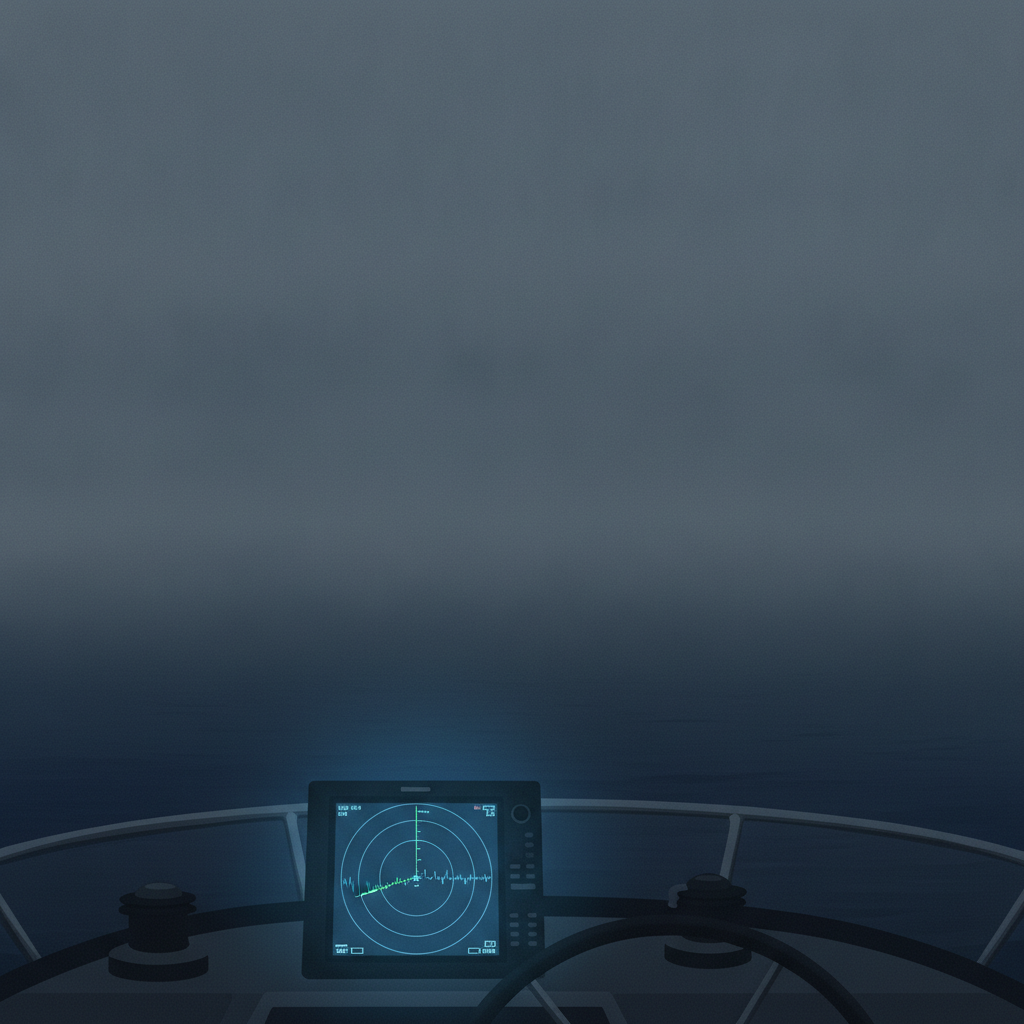
Fog is a great leveller. The vessel that holds right of way in clear conditions loses that privilege the moment visibility closes in, and every skipper, whether threading through a busy traffic separation scheme or creeping into a familiar anchorage, faces the same set of obligations. Rule 19 is the rule that governs conduct in restricted visibility, and understanding it properly is one of the most practically important things you can do for your seamanship.
The core shift that Rule 19 makes is deceptively simple: the give-way and stand-on framework of Rules 12 to 18 no longer applies between vessels that cannot see each other. That framework depends on visual contact and a shared understanding of who has priority. Take away the ability to see, and the whole structure collapses. Rule 19 replaces it with a set of precautionary obligations that apply to every vessel equally, regardless of her type, propulsion or manoeuvring ability.
This does not mean the clear-weather rules disappear entirely. If two vessels are close enough to see each other even in fog, perhaps through a brief clearing or in visibility that is patchy rather than total, then Rules 12 to 18 snap back into relevance. Rule 19 is explicit that it applies only to vessels not in sight of one another. But in practice, whenever visibility is significantly reduced by fog, mist, heavy rain, snow or any similar condition, you should be operating on the assumption that Rule 19 governs your conduct. This article is educational support and does not replace formal training or the official COLREGS publication.
Safe Speed: Slower Than You Think
Rule 6 requires every vessel to proceed at a safe speed at all times, but Rule 19 reinforces this with specific emphasis on restricted visibility. Safe speed is not a single figure. It is the speed that allows you to take proper and effective action to avoid collision and to stop within a distance appropriate to the prevailing circumstances. In fog, those circumstances change dramatically: your detection range may be limited, your radar picture may be cluttered, and other vessels may have no idea you are there.
Rule 19(b) requires power-driven vessels to have engines ready for immediate manoeuvre. This is a distinct obligation sitting alongside the safe speed requirement. A vessel running at or near full speed in fog, with engines set for economical cruising, may not have the immediate stopping power the situation demands. Reducing speed is not timidity. It is compliance.
The question candidates often struggle with is how slow is slow enough. The honest answer is that it depends on your vessel, your radar capability, traffic density and visibility range. A large ship with reliable radar in moderate fog has different options from a 10-metre yacht with a handheld set in a dense sea fret. What the rules demand is that you think it through and arrive at a speed you can genuinely justify, not the speed that gets you home on time.
The Radar-Detected Close-Quarters Problem
This is where Rule 19 gets demanding, and where exam candidates and real skippers sometimes come unstuck. Rule 19(d) deals with what you must do when you detect another vessel by radar alone and determine that a close-quarters situation is developing or that a risk of collision exists.
The rule requires you to take avoiding action in ample time. That phrase carries real weight. It means acting early, before the situation becomes urgent, while you still have sea room and options. Waiting until the contact is close before you act is exactly the sort of last-minute, reactive response that the rules are designed to prevent.
When avoiding action consists of an alteration of course, Rule 19(d) requires that, so far as possible, certain manoeuvres are avoided. Specifically, an alteration of course to port for a vessel forward of the beam shall be avoided, other than where that vessel is being overtaken. An alteration of course towards a vessel abeam or abaft the beam shall also be avoided. These are not two "approved categories" of action. They are constraints on course alterations, sitting alongside the broader options of reducing speed, stopping or going astern, which may be used independently or in combination.
The underlying logic is risk management. A turn to port when another vessel is somewhere ahead on your port bow may swing your bow directly into her path. You are dealing with incomplete information: you know where the echo is now, but not exactly where the other vessel is heading or how quickly she is manoeuvring. The rules steer you toward the statistically safer choices, whether that means reducing speed, stopping, going astern, or altering to starboard where sea room permits.
It is equally important to be clear about when Rule 19(d) does not apply. Rule 19 governs only vessels not in sight of one another. If a vessel becomes visible, even briefly, the give-way and stand-on framework of Rules 12 to 18 applies instead. You cannot invoke Rule 19(d) constraints as a justification for any manoeuvre once the other vessel is in sight.
You can explore the structure of Rule 19 alongside the surrounding rules in the IRPCS rule library at /#learn, where each rule is broken down with annotations.
Rule 19(e): When a Fog Signal Is Heard Forward of the Beam
Rule 19(e) addresses a distinct and particularly demanding situation. Where a vessel hears, apparently forward of her beam, the fog signal of another vessel, or where a close-quarters situation with a vessel forward of the beam cannot be avoided, Rule 19(e) requires the vessel to reduce her speed to the minimum at which she can be kept on course. If necessary, she must take all way off and navigate with extreme caution until the danger of collision is over.
This sub-paragraph is separate from the course-alteration constraints in Rule 19(d). Rule 19(e) is triggered by a heard fog signal forward of the beam, or by the unavoidability of a close-quarters situation with a vessel in that arc. Its response is a speed reduction to bare steerageway or stopping entirely, combined with extreme caution. The two sub-paragraphs address different scenarios and carry different required responses, and confusing them is a common exam error.
There Is No Stand-On Vessel in Fog
This point cannot be overstated, because it represents the sharpest conceptual break between fog rules and clear-weather rules. In clear visibility, a sailing vessel crossing ahead of a power-driven vessel is the stand-on vessel. She maintains course and speed; the power-driven vessel gives way. That is Rule 18.
In fog, if neither vessel can see the other, Rule 18 is irrelevant. Both vessels are under Rule 19. Both have equal obligations to proceed at a safe speed, to listen for sound signals, to use radar if fitted, and to take avoiding action in ample time if a close-quarters situation develops. Neither can simply hold her course and speed on the grounds that she would normally be the stand-on vessel.
This catches out sailors in particular, who are accustomed to having priority over power in most crossing situations. Under Rule 19, a sailing yacht in fog is not privileged relative to a motor vessel she cannot see. Both vessels carry identical obligations, and the fact that one would normally stand on is simply not part of the calculation.
Sound signals remain important in this picture. Rule 35 governs sound signals in restricted visibility and requires vessels underway to make signals at intervals of not more than two minutes. Keeping a careful listening watch alongside your radar watch is not optional.
Practical Habits That Make a Difference
Beyond the rule mechanics, there are practical habits that separate skippers who manage restricted visibility well from those who merely survive it. Posting a dedicated lookout, someone whose sole job is listening and watching, is one of the most effective measures on a small vessel where the helm is often also navigating and monitoring radar.
AIS is valuable but dangerous to over-rely on. Not every vessel carries AIS, and even those that do may transmit intermittently or with position errors. Radar remains the primary electronic detection tool in restricted visibility, and using it with proper range scale selection and clutter suppression is a skill that benefits from regular practice in good conditions, not just when the fog rolls in.
Finally, consider your escape routes before you need them. In fog, knowing that you have sea room to starboard, or that there is an anchorage within two miles, gives you options. Running blind down a narrow channel with no contingency is exactly the kind of situation Rule 19 was written to discourage.
If you want to test your understanding before an exam or a passage, the practice quizzes at /#quiz include dedicated restricted visibility scenarios that will press you on exactly these points.
FAQ
Does Rule 19 apply in heavy rain or only in fog? Rule 19 applies in all conditions of restricted visibility, which includes fog, mist, falling snow, heavy rainstorms, sandstorms and any other similar causes. The key test is whether visibility is significantly reduced, not whether the specific cause is fog. Rule 3(l) sets out the full definition.
If I can see another vessel in fog, which rules apply? If vessels are in sight of one another, even briefly through patchy fog, the give-way and stand-on framework of Rules 12 to 18 applies. Rule 19 governs only vessels not in sight of one another. In practice, patchy visibility requires constant reassessment of which regime you are operating under.
Can I ever alter to port in fog? Yes, in many circumstances. The constraint in Rule 19(d) applies specifically when you have detected a vessel forward of your beam by radar alone and a close-quarters situation is developing or a risk of collision exists. In that scenario, an alteration of course to port for that vessel shall, so far as possible, be avoided. Outside that scenario, a turn to port is not automatically prohibited under Rule 19.
What is the difference between Rule 19(d) and Rule 19(e)? Rule 19(d) deals with radar-detected vessels and constrains which course alterations are appropriate when a close-quarters situation is developing. Rule 19(e) is triggered when a fog signal is heard apparently forward of the beam, or when a close-quarters situation with a vessel forward of the beam cannot be avoided. Its required response is to reduce to bare steerageway or stop, and to navigate with extreme caution. The two sub-paragraphs address different triggers and require different responses.
Drill it until it's instinct.
The IRPCS app turns every rule on this blog into adaptive quizzes, drills, and mock exams - free to start.