
Rule 7: How to Decide Whether Risk of Collision Exists
Constant bearing, radar, and scanty information - the watchkeeping habits that Rule 7 demands every officer of the watch builds into muscle memory.
12 October 2026 · 7 min read · IRPCS crew
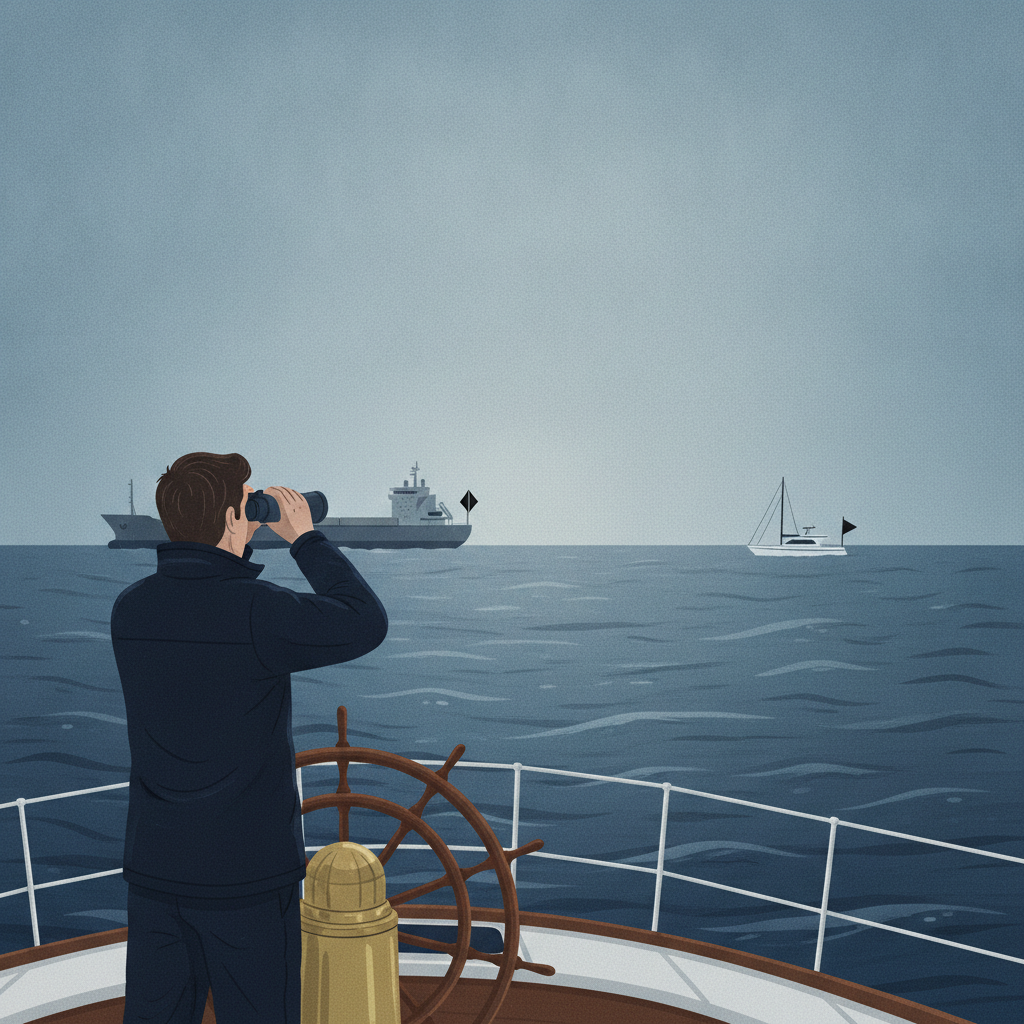
There is a moment familiar to every watchkeeper: a vessel appears on the horizon, and the question arrives almost before the binoculars are raised. Is that a problem? Rule 7 of the COLREGS is the rule that governs how you answer that question. It does not tell you what to do once you have answered it - that is the job of Rules 8, 13, 14, 15, 16, and 17. Rule 7 simply tells you how to make the determination honestly, systematically, and in good time.
What makes Rule 7 worth studying carefully is not just its content but its philosophy. The rule is built around a principle of caution: if you are not sure, you must assume the worst. That single idea, properly understood, changes the way a good watchkeeper thinks about every contact on the water.
What Rule 7 Actually Requires
Rule 7 requires every vessel to use all available means appropriate to the prevailing circumstances and conditions to determine whether risk of collision exists. That phrase - all available means - is not decorative. It is a direct challenge to the habit of relying on a single source of information when several are within reach.
On a yacht with a working chartplotter, AIS, and a hand-bearing compass, using only a glance over the spray-hood is not enough. On a ship with ARPA radar, AIS, and a qualified officer of the watch, failing to plot a contact is a failure to comply with Rule 7. The equipment list varies enormously between vessels, but the obligation to use what you have is universal.
The rule also specifically addresses radar. Where radar is fitted and operational, Rule 7 requires that it be used properly - including, where appropriate, long-range scanning to give early warning, and the use of radar plotting or an equivalent systematic observation. This is one of the COLREGS' more explicit concessions to technology, and it reflects hard lessons from collision investigations in which radar was fitted but not used, or used but not plotted.
The Compass Bearing Test
The most powerful and most underused tool in Rule 7's toolkit is the compass bearing. The rule states clearly that risk of collision shall be deemed to exist if the compass bearing of an approaching vessel does not appreciably change.
A bearing that stays constant - or nearly so - while the range decreases means your vessel and the other are on converging courses. Geometry guarantees a meeting point. This is the classic constant-bearing, closing-range situation, and it does not matter whether you are looking at it from a supertanker or a coastal cruiser.
In practice, taking a single bearing tells you almost nothing. The test requires a series of bearings taken at regular intervals, with the time and bearing recorded. Three minutes between bearings is a reasonable starting point in open water; in confined waters or at high closing speeds, the interval needs to be shorter. Recording the bearings rather than simply memorising them removes the bias that makes watchkeepers remember the bearing they wanted to see.
A bearing that is drawing forward - increasing relative to your vessel's head - generally suggests the other vessel will pass ahead. A bearing drawing aft suggests a pass astern. But neither conclusion is safe until the vessels are well clear and the risk is truly over. Bearings can shift deceptively when both vessels are altering course, and a contact that appeared to be drawing clear can rapidly become a close-quarters situation.

Scanty Information and the Duty of Doubt
One of Rule 7's most important provisions deals directly with uncertainty. The rule states that if there is any doubt about whether risk of collision exists, it shall be assumed to exist. This is not a counsel of timidity - it is a legal and practical instruction that protects everyone on the water.
The phrase scanty information appears in the rule to capture the situation where you simply do not have enough data to be confident either way. Poor visibility, a contact on the edge of radar range, a vessel not transmitting AIS, a busy anchorage where bearings are difficult to isolate - all of these create conditions of scanty information. Rule 7 says that in those conditions, doubt resolves in favour of caution.
This matters enormously for watchkeeping culture. A common failure mode in collision investigations is the watch officer who, lacking clear evidence that there was a risk, concluded there was none. Rule 7 inverts that logic. The absence of evidence that risk does not exist is itself evidence that it might.
For exam candidates, this point is often tested precisely because it runs against intuition. Train yourself to state it clearly: doubt triggers the assumption of risk, not the assumption of safety.
You can test your understanding of this and related rules in the IRPCS practice quiz - it is worth running through the Rule 7 and Rule 8 questions together, since the two rules form a natural pair.
Building the Habit: Watchkeeping in Practice
Rule 7 compliance is not a one-time check - it is a continuous process throughout a watch. Experienced watchkeepers develop a rhythm: sweep the horizon, note new contacts, begin bearing observations on anything that might close, review existing contacts for bearing change, consult radar if fitted. That rhythm becomes automatic, but it starts with deliberate practice.
A few habits that embed Rule 7 properly:
Take bearings in series, not isolation. A single bearing is only a starting point. Log the time, log the bearing, take another in three to five minutes, and compare. The trend matters far more than any individual reading.
Name your contacts. Whether mentally or on a plotting sheet, giving a contact a label - the red hull to the north-west, target alpha on the radar - forces you to track it consistently across multiple observations rather than losing it in the visual clutter.
Use radar range rings actively. On a steady radar picture, watching whether a contact is moving inward through the range rings is an immediate cross-check on bearing observations. The two methods together are far more reliable than either alone.
Vocalise doubt. If you are uncertain whether a contact is closing or drawing clear, say so - to a crewmate, to yourself in a log entry, or simply as a conscious internal statement. Naming uncertainty makes it easier to act on it rather than explain it away.
Check back after any manoeuvre. If you alter course or speed for any reason, recheck all contacts. Your own manoeuvre changes the geometry for every vessel around you, and a contact that was drawing clear may no longer be doing so.
The full text and structure of Rule 7 alongside its neighbours in the steering and sailing rules are available in the IRPCS rule library, which is worth bookmarking for quick reference during study.
FAQ
Does Rule 7 only apply in restricted visibility? No. Rule 7 applies in all conditions and at all times. The rule makes no distinction between clear weather and restricted visibility - it governs the determination of risk in every circumstance. Restricted visibility triggers additional rules (principally Rule 19), but the obligation to assess risk of collision under Rule 7 never switches off.
What counts as 'all available means' on a small yacht? It depends entirely on what is fitted and working. A yacht with only a hand-bearing compass is not expected to have ARPA radar. But it is expected to use that compass systematically. If the yacht also has a chartplotter with AIS overlay, then monitoring that display is part of the obligation. Available means present and operational, not merely theoretically possible.
If the bearing is changing, does that mean there is definitely no risk? Not necessarily. A changing bearing reduces the likelihood of collision but does not eliminate risk entirely, particularly at close range. Rule 7 uses the word appreciably - a very slow bearing change in a closing situation may not be enough to ensure the vessels will pass safely. Watchkeepers should continue monitoring until vessels are clearly past and well clear.
How does AIS fit into Rule 7's 'all available means' requirement? AIS is a legitimate tool for assessing risk, and when fitted and receiving, it should be used as part of the overall picture. However, COLREGS guidance and general seamanship practice caution against relying on AIS alone: not all vessels transmit, data can be inaccurate, and system latency means AIS is not a substitute for visual and radar observation. Use it as one layer of information, not the only layer.
Drill it until it's instinct.
The IRPCS app turns every rule on this blog into adaptive quizzes, drills, and mock exams - free to start.