Day Shapes Decoded: Balls, Cones and Diamonds Explained
Every COLREGS day shape demystified: what each ball, cone, diamond and cylinder means, which rule governs it, and how to remember them for your exam.
16 October 2026 · 9 min read · IRPCS crew
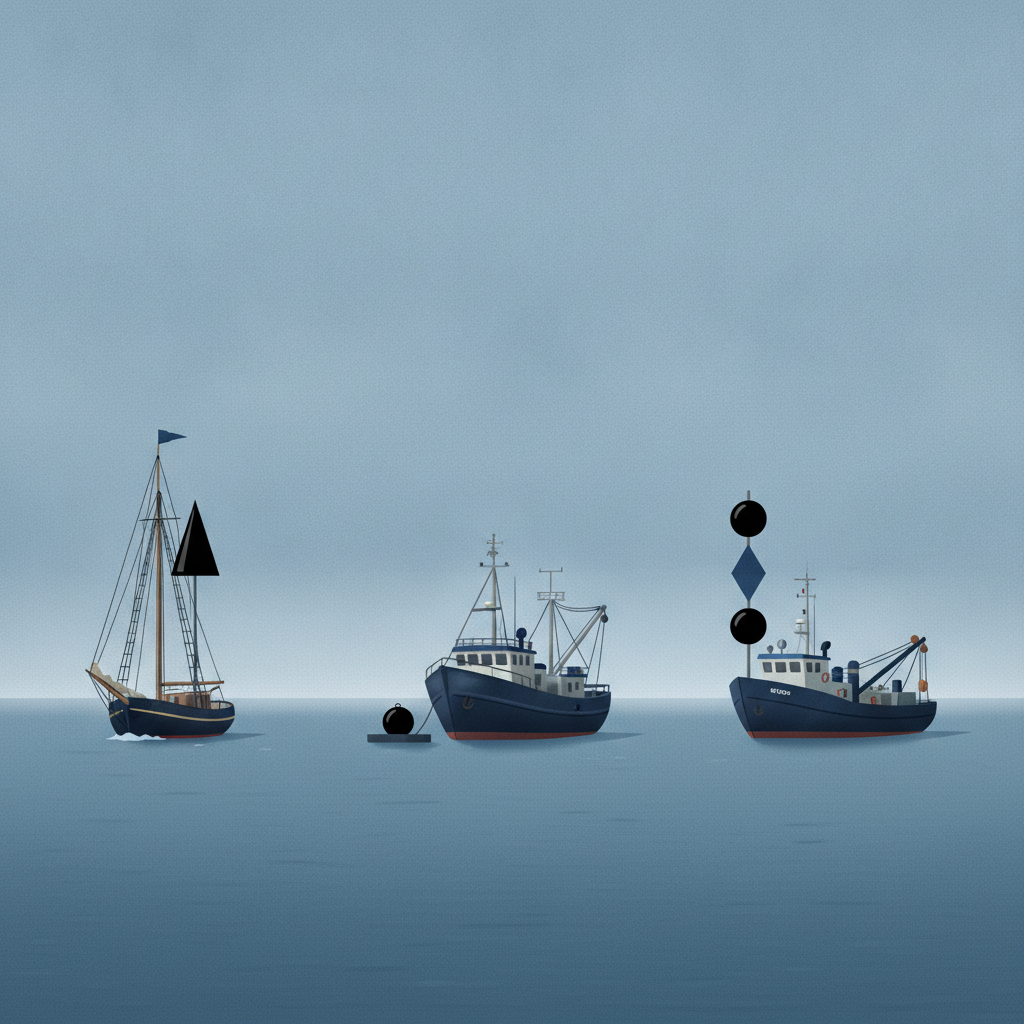
Ask most skippers what a black ball displayed forward means and they will tell you confidently: vessel at anchor. Ask them what a ball over a diamond over a ball means and the confidence sometimes wobbles. Day shapes are one of those topics that feels straightforward until the exam puts three options in front of you that all contain a cone.
The good news is that the whole system is more logical than it first appears. Once you understand which shapes belong to which broad category of vessel, the specific combinations click into place quickly.
Shapes are displayed by day when a vessel's status means other traffic needs to know how she is constrained; at night the same information is carried by lights, and the logic mirrors them closely. This article is educational support. It does not replace the official COLREGS text, which is the only authoritative source, or formal training with a qualified instructor or examiner.
The Four Building Blocks
The COLREGS use just four geometric shapes: the ball, the cone, the diamond (two cones joined base to base) and the cylinder. Everything else is a combination or repetition of these four. Annex I requires all of them to be black.
Each shape appears in more than one context, so treat the following as a map rather than a set of fixed meanings:
- Ball: one for at anchor, two in a vertical line for not under command, three in a vertical line for aground, three spread across the foremast and fore yard for mine clearance, the top and bottom of the ball-diamond-ball combination, and two on the obstructed side of a dredger
- Cone: apex downwards for a sailing vessel under power, two with apexes together for a vessel engaged in fishing, and one apex upwards pointing towards outlying fishing gear
- Diamond: the middle of the ball-diamond-ball combination, on vessels involved in a tow exceeding 200 metres, and two on the side of a dredger that is safe to pass
- Cylinder: a vessel constrained by her draught, and nothing else
The diamond in particular wears several hats. Treating it as belonging exclusively to towing is one of the most common exam mistakes.
At Anchor, Not Under Command and Aground
Rule 30 governs vessels at anchor and aground. A vessel at anchor exhibits one ball in the fore part, where it can best be seen (Rule 30(a)(i)). That is the whole shape requirement, whatever the vessel's length. Rule 30 does draw distinctions by length, but they concern lights: a second all-round white light at or near the stern, the option for vessels under 50 metres to show a single all-round white light instead, and the requirement for vessels of 100 metres and more to illuminate their decks (Rule 30(c)). There is no second anchor ball for large ships. If you see two balls in a vertical line, you are not looking at a big vessel at anchor.
Two balls in a vertical line is the signal for a vessel not under command (Rule 27(a)(ii)). A NUC vessel is one that, through some exceptional circumstance, cannot manoeuvre as the rules require, and the shape tells you that she cannot get out of your way.
A vessel aground exhibits the anchor shape and, in addition, three balls in a vertical line (Rule 30(d)(ii)).
Two exemptions are worth knowing: a vessel under 7 metres at anchor away from channels, fairways, anchorages and where other vessels normally navigate need not show the anchor ball (Rule 30(e)), and a vessel under 12 metres aground need not show the aground shapes (Rule 30(f)).
Restricted in Ability to Manoeuvre
A vessel restricted in her ability to manoeuvre, such as a dredger, survey ship or cable layer, exhibits three shapes in a vertical line: a ball, a diamond and a ball (Rule 27(b)(ii)). That sandwich is worth burning into memory. The shapes describe the constraint, not the speed: a RAM vessel making way still shows them.
A vessel engaged in dredging or underwater operations adds more when an obstruction exists (Rule 27(d)). On the side where the obstruction lies she exhibits two balls in a vertical line, and on the side on which another vessel may pass she exhibits two diamonds in a vertical line. Both sit alongside the ball-diamond-ball. The diamonds here mean "pass this side", which is exactly why the diamond cannot be read as a towing signal in isolation.
Diving operations come under Rule 27(e). A vessel engaged in diving normally exhibits the Rule 27(d) signals. Where her size makes it impracticable to exhibit all of them, she exhibits instead the red-white-red lights and a rigid replica of International Code flag A, not less than 1 metre in height, visible all round. The rigid flag A is the answer for small dive boats that cannot rig the full set, not a general alternative for any vessel that finds the shapes inconvenient.
Mine clearance is Rule 27(f). In addition to her ordinary lights or shapes, a vessel engaged in mine clearance operations exhibits three balls: one near the foremast head and one at each end of the fore yard. The rule states that these shapes indicate it is dangerous for another vessel to approach within 1000 metres. The spread arrangement across the yard is what distinguishes mine clearance from a vessel aground, whose three balls hang in a single vertical line. You can read more about each of these vessel types in the IRPCS rule library.
Fishing Vessels
Rule 26 gives fishing vessels a shape of their own: two cones with their apexes together in a vertical line, one above the other. It is the same shape whether the vessel is trawling (Rule 26(b)(i)) or fishing by some other method (Rule 26(c)(i)). The lights differ, green over white for a trawler and red over white for other fishing, but the day shape does not.
A vessel fishing other than by trawling that has outlying gear extending more than 150 metres horizontally also exhibits a cone, apex upwards, in the direction of the gear (Rule 26(c)(ii)).
Sailing Under Power, and Towing
Rule 25(e) requires a vessel proceeding under sail when also being propelled by machinery to exhibit forward, where it can best be seen, a conical shape with the apex downwards. This catches out racing and cruising sailors because it feels counterintuitive: under sail alone a yacht needs no shape at all. It is the moment you engage the engine that your status changes, and the cone declares it.
Towing shapes live in Rule 24 and turn on a single threshold: whether the length of the tow, measured from the stern of the towing vessel to the after end of the tow, exceeds 200 metres. When it does, the towing vessel exhibits a diamond where it can best be seen (Rule 24(a)(v)) and the vessel or object being towed exhibits a diamond as well (Rule 24(e)(iii)). The key word is "exceeds", not "equals". An inconspicuous, partly submerged tow such as a dracone has its own provision: a diamond at or near its aftermost extremity, with an additional diamond as far forward as practicable when the tow exceeds 200 metres (Rule 24(g)(iv)).
Constrained by Draught
Rule 28 allows a vessel constrained by her draught to exhibit, in addition to her lights as a power-driven vessel, three all-round red lights in a vertical line or, by day, a cylinder. The word "may" is deliberate and examinable: Rule 28 is permissive, where the NUC, RAM and fishing shapes are mandatory when the conditions apply.
Two further points follow from the definition in Rule 3(h). Only a power-driven vessel can be constrained by her draught, so a sailing vessel never shows a cylinder. And the choice to display the signal has consequences: Rule 18(d) asks every vessel other than one not under command or restricted in her ability to manoeuvre to avoid impeding the safe passage of a vessel constrained by her draught that is exhibiting the Rule 28 signals.
A Memory Framework for the Exam
Grouping by shape and count is the fastest way to recall day shapes under pressure:
- One ball, forward: at anchor (Rule 30)
- Two balls, vertical: not under command (Rule 27)
- Three balls, vertical: aground, with the anchor ball (Rule 30)
- Three balls, foremast head and each end of the fore yard: mine clearance (Rule 27(f))
- Ball, diamond, ball, vertical: restricted in ability to manoeuvre (Rule 27)
- Two balls one side, two diamonds the other: dredger with an obstruction, pass on the diamond side (Rule 27(d))
- Two cones, apexes together: engaged in fishing (Rule 26)
- One cone, apex up: direction of fishing gear extending more than 150 metres (Rule 26(c))
- One cone, apex down, forward: sailing vessel under power (Rule 25(e))
- Diamond on towing vessel and tow: tow exceeding 200 metres (Rule 24)
- Cylinder: constrained by draught, optional (Rule 28)
The practice quiz on IRPCS includes day-shape recognition questions and will quickly show you which of these have not yet stuck.
FAQ
Do day shapes need to be a particular size? Yes. Annex I, section 6 specifies that shapes shall be black, that a ball shall have a diameter of not less than 0.6 metre, that a cone shall have a base diameter of not less than 0.6 metre and a height equal to its diameter, that a cylinder shall have a diameter of at least 0.6 metre and a height of twice its diameter, and that a diamond consists of two such cones with a common base. The vertical distance between shapes shall be at least 1.5 metres. A vessel of less than 20 metres may use shapes of lesser dimensions commensurate with her size, with the spacing correspondingly reduced.
If a vessel is constrained by draught, must she show a cylinder? No. Rule 28 says "may", so the display is optional. That contrasts with the NUC and RAM shapes under Rule 27 and the fishing shapes under Rule 26, which are required whenever the conditions apply. Knowing which signals are mandatory and which are permissive is a useful revision category in its own right.
How do I tell mine clearance from aground when both use three balls? By geometry. A vessel aground shows three balls in a single vertical line, plus the anchor ball forward (Rule 30(d)). A mine clearance vessel shows one ball near the foremast head and one at each end of the fore yard, spread across the width of the vessel (Rule 27(f)).
Can a vessel display shapes voluntarily when they do not apply? No. Every shape carries a precise meaning, and displaying one that does not match your situation misleads other traffic. Rule 26(e) says it explicitly for fishing vessels: a vessel not engaged in fishing shall not exhibit the fishing lights or shapes.
Drill it until it's instinct.
The IRPCS app turns every rule on this blog into adaptive quizzes, drills, and mock exams - free to start.