Cardinal Marks: A Memory System That Survives a Night Watch
Topmark arrows, clock-face light rhythms, and exactly where the safe water is. A practical memory guide to IALA cardinal marks for skippers and exam candidates.
24 August 2026 · 7 min read · IRPCS crew
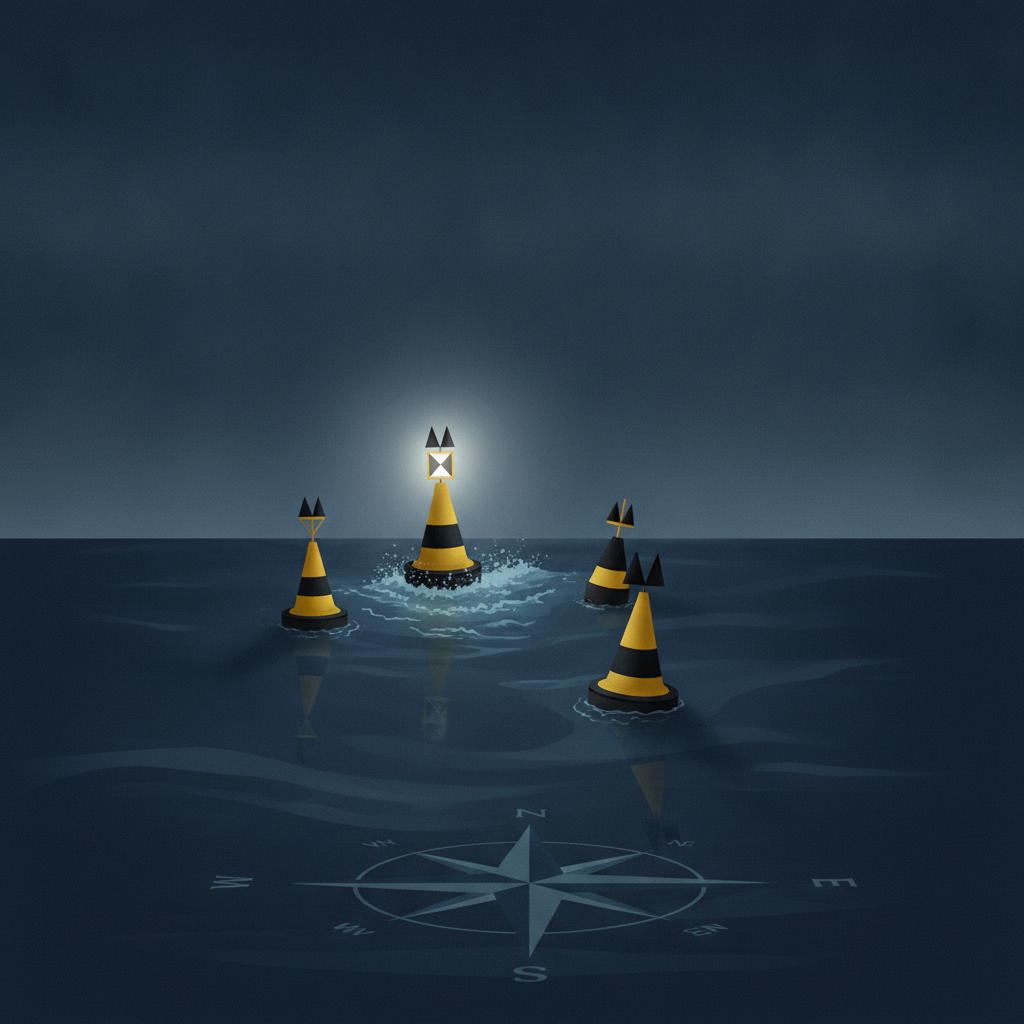
Cardinal marks are one of those topics that feel straightforward in a classroom and genuinely tricky at three in the morning with a headwind and tired eyes. The shapes are logical, the colours follow a pattern, and the light rhythms have an elegant underlying system - but only if someone shows you the thread that connects them. Once you see it, you will not forget it.
This guide is built around that thread: a clock-face analogy that ties the four cardinal marks together so that knowing one gives you the others for free. We will cover topmarks, colour banding, light rhythms, and - crucially - what "pass on the named side" actually means in practice. None of this replaces formal study or an RYA/MCA course, but it should make the next time you open a chart or walk into an exam room feel considerably more comfortable.
What a Cardinal Mark Is Actually Telling You
A cardinal mark belongs to the IALA buoyage system. Its job is to indicate the direction of the nearest safe water relative to a hazard. The name comes from the cardinal points of the compass: North, East, South, and West. A North cardinal mark tells you that the safe water lies to the north of the mark - so you should pass it on its north side. The same logic applies to each of the others.
That one sentence - safe water is on the named side - is the most important thing to fix in your memory before you worry about anything else. When you see a North cardinal, go north of it. When you see a South cardinal, go south of it. The mark is placed on the hazard's edge, pointing you away from danger.
Cardinal marks are pillar or spar shaped, painted in yellow and black bands, and carry double-cone topmarks. The arrangement of those cones and bands is where the memory system begins.
Topmarks: Points Tell You Where to Look
Every cardinal mark carries two black cones as a topmark. The orientation of those cones is the most reliable daytime identifier you have, because it encodes both the name of the mark and the direction of safe water at the same time.
Here is the rule: the points of the cones always indicate black.
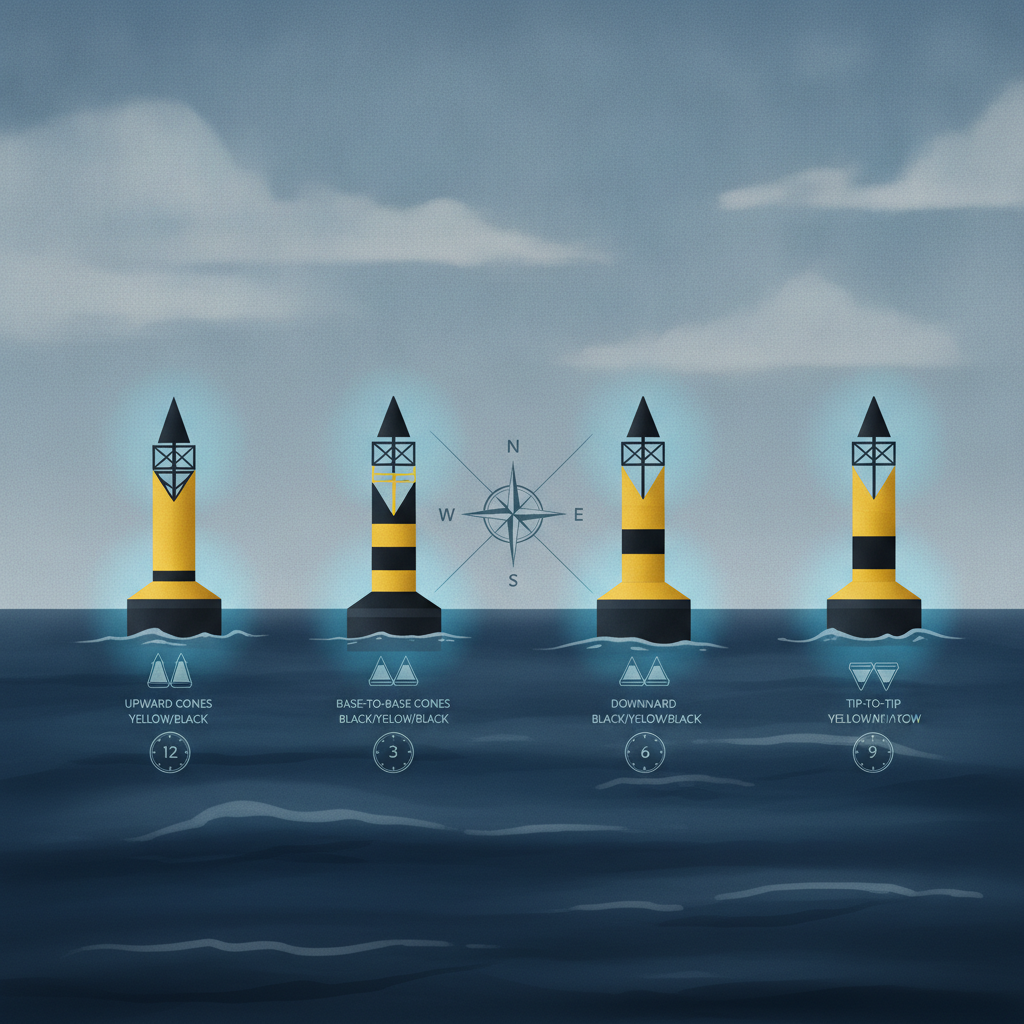
- North: both cones point upward (points up, black is on top - like a compass needle reaching north).
- South: both cones point downward (points down, black is on the bottom).
- East: the cones point away from each other, base to base, forming a diamond or egg shape.
- West: the cones point toward each other, tip to tip, forming a waist or wineglass shape.
The East and West marks are the ones candidates muddle. A useful mnemonic is to think of the letter shapes: East makes an Egg (wide in the middle), West makes a Waist (narrow in the middle). Once that image is fixed, the North and South follow naturally from "points indicate black."
The colour banding reinforces the topmark. On a North cardinal, black is on top and yellow below. On a South cardinal, yellow is on top and black below. East carries black-yellow-black banding (black at both ends, like the tips of the egg-shaped topmark). West carries yellow-black-yellow (yellow at both ends, matching the wide parts of the wineglass).
Light Rhythms: The Clock Face System
At night, cardinal marks show white quick-flashing or very quick-flashing lights. This is where the clock-face analogy earns its keep.
Imagine a clock. The cardinal marks occupy four positions:
- North is at 12 - continuous flashing (or very quick flashing - no interruptions, just like the top of the clock is unbroken).
- East is at 3 - three flashes, then a pause.
- South is at 6 - six flashes, then a long flash, then a pause.
- West is at 9 - nine flashes, then a pause.
The numbers 3, 6, and 9 come directly from the clock positions of East, South, and West. North, sitting at 12, is the continuous one because 12 does not reduce neatly to a single digit in the sequence - so it simply keeps going.
The South mark gets a long flash added after its six short flashes. This is a deliberate safety feature: six and nine flashes are easy to miscount in poor conditions, so the long flash after South's sequence gives you a definitive identifier. If you count roughly six and then see a noticeably longer flash before the pause, you are looking at a South cardinal. If you count roughly nine with no long flash, it is West.
All four marks can operate in either quick-flashing (Q) or very quick-flashing (VQ) mode. Very quick-flashing marks simply run the same rhythm at a higher rate. On a chart or in a light list, you might see Q(3) for an East cardinal in quick mode, or VQ(9) for a West in very quick mode. The number in brackets is your clock-face number.
If you want to test yourself on identifying these rhythms before your next passage, the practice quiz at /#quiz includes cardinal mark light-identification questions alongside other buoyage and COLREGS topics.
Putting It Together: A Quick Reference
Here is the full picture in one place:
| Mark | Topmark | Banding | Light rhythm | Safe water |
|---|---|---|---|---|
| North | Both cones up | Black over yellow | Q or VQ (continuous) | North of mark |
| East | Base to base (egg) | Black-yellow-black | Q(3) or VQ(3) | East of mark |
| South | Both cones down | Yellow over black | Q(6)+long flash or VQ(6)+long flash | South of mark |
| West | Tip to tip (waist) | Yellow-black-yellow | Q(9) or VQ(9) | West of mark |
Print this table, stick it in your chart table, and quiz yourself until you can reproduce it without looking. Then use the clock-face as your backup: if you can picture a clock, you can reconstruct the light rhythms anywhere.
On the Water: Common Situations
Cardinal marks appear wherever a single directional reference makes more sense than a lateral channel mark. Isolated dangers offshore, wrecks, sandbanks that extend in one direction, headlands where the shoal runs to one side - these are typical situations.
A practical point: when you spot a cardinal mark at night and begin counting flashes, start counting from the beginning of a group, not partway through. If you join the sequence mid-cycle you will miscount. Wait for the pause, let the next group begin, and count cleanly. With VQ marks running at 120 flashes per minute, a brief observation period is usually enough to catch two or three full cycles.
Also remember that the mark tells you where safe water is, not that all other water around it is uniformly dangerous. Always cross-reference the chart. The cardinal mark is a navigational signpost, not a substitute for understanding the local bathymetry.
For deeper background on how cardinal marks sit within the wider IALA framework alongside lateral, isolated danger, safe water, and special marks, the rule library at /#learn is a useful reference alongside your chart publications.
FAQ
Why does the South cardinal have a long flash and the others don't? The long flash is added specifically to prevent confusion between South (six flashes) and West (nine flashes) in poor visibility or when tired. A long flash is distinctly longer than the short flashes in the group, making it unmistakable once you know to look for it. It is the one quirk in an otherwise symmetrical system, and it is there for good reason.
Does it matter whether a mark is quick-flashing or very quick-flashing? For identification purposes the rhythm is identical - three, six, nine, or continuous. The difference in rate (Q versus VQ) is recorded on the chart and in light lists and may affect how easy the mark is to spot and count in practice, but the clock-face memory system applies equally to both.
What if I cannot see the topmark at night? The light rhythm is your primary night identifier. The topmark is the primary daytime identifier. In good conditions by day you may be able to confirm both, which adds confidence. At night, count the rhythm, reference the clock face, and cross-check against the charted position. Never rely on a single source of information alone.
Are cardinal marks part of COLREGS? Cardinal marks belong to the IALA buoyage system rather than the COLREGS directly, though Rule 5 (the look-out rule) and Rule 7 (risk of collision) create the broader duty to correctly identify and respond to all marks and lights around you. Understanding buoyage is inseparable from safe collision-avoidance practice, which is why exam syllabuses treat them together.
Drill it until it's instinct.
The IRPCS app turns every rule on this blog into adaptive quizzes, drills, and mock exams - free to start.