
Stand-On vs Give-Way: Who Moves, and When Rules Change
Rule 16 and Rule 17 explained clearly - including the moment a stand-on vessel must stop standing on and take action.
10 June 2026 · 8 min read · IRPCS crew
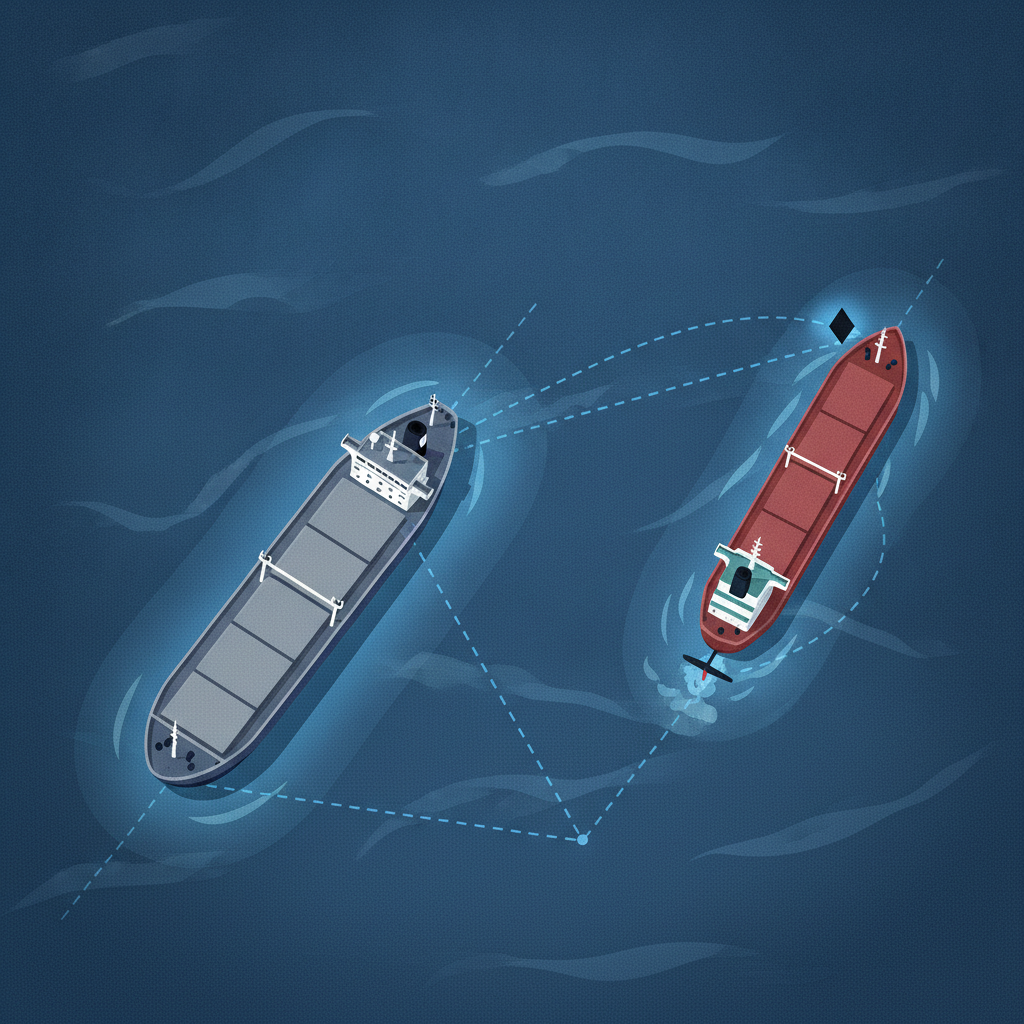
Ask most skippers which vessel moves in a crossing situation and you will get a confident answer. Ask them when the other vessel is also required to move, and the confidence often evaporates. The stand-on and give-way relationship is one of the most rehearsed concepts in COLREGS training - and one of the most incompletely understood in practice.
The core idea sounds simple: one vessel keeps clear, the other holds course and speed. But this tidy division of labour carries important conditions on both sides. The give-way vessel has a clear, positive duty. The stand-on vessel has real obligations too, ones that can and do kick in before a collision is imminent. Getting this wrong is not just an exam failure - it is how collisions happen in clear weather between vessels that both had plenty of time to act.
This article unpacks the full picture: what Rule 16 actually demands, what Rule 17 permits and then requires, and how to think about the transition from "hold course" to "take action" in the real world.
Rule 16: The Give-Way Vessel's Duty
Rule 16 applies to any vessel that the Rules designate as the give-way vessel in a given encounter - whether that arises from a crossing situation under Rule 15, an overtaking situation under Rule 13, or any other applicable rule. The obligation is not simply to "get out of the way" in a casual sense. Rule 16 requires the give-way vessel to take early and substantial action to keep well clear.
Three words in that duty deserve attention. Early means you should not wait until the last moment - a give-way vessel that begins a modest alteration with a minute to spare is not complying in spirit. Substantial means the action must be large enough to be obvious to the other vessel - a five-degree course change registered on radar is not substantial. Well clear means a comfortable margin, not a near miss navigated successfully.
In practical terms, a give-way vessel should alter course and/or speed decisively, and preferably in a direction and by an amount that makes its intentions unmistakable. A bold alteration to starboard in a crossing situation, for example, sends a clear visual and radar signal. Slowing gradually does not.
Rule 17: The Stand-On Vessel's Obligations
Rule 17 is where the misunderstanding concentrates. Most people remember the first part: the stand-on vessel is required to maintain its course and speed. What they underweight are the qualifications that follow.
Rule 17(a)(ii) permits the stand-on vessel to take action as soon as it becomes apparent that the give-way vessel is not taking appropriate action. This is a permission, not yet a requirement - but it is an important permission. It means that holding course rigidly while watching a give-way vessel fail to act is not the only lawful option. You are entitled to move.
Rule 17(b) goes further. It requires the stand-on vessel to take action when collision cannot be avoided by the give-way vessel alone. At that point, the stand-on vessel is no longer just permitted to manoeuvre - it must.
Rule 17(c) adds a specific steer on how that action should be shaped: it cautions against altering course to port for a vessel on your own port side. This constraint reflects the geometry of most crossing encounters and the real risk of both vessels turning towards each other simultaneously.
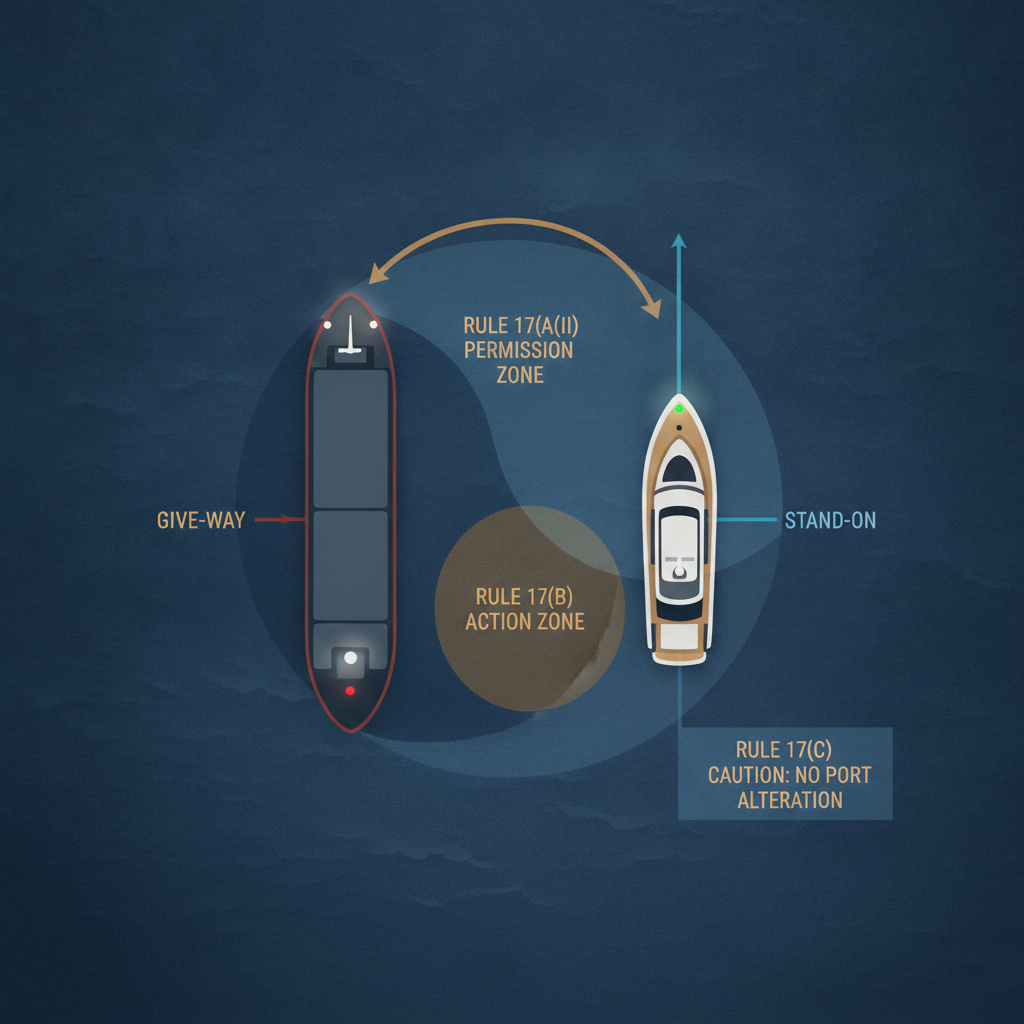
The transition from Rule 17(a)(i) - hold your course - through 17(a)(ii) - you may act - to 17(b) - you must act - is not a precise line. It is a sliding scale driven by the developing situation. A prudent mariner watches that progression in real time and thinks ahead about what action they would take and when.
The Rule 2 Overlay: Good Seamanship Always Applies
Neither Rule 16 nor Rule 17 operates in isolation. Rule 2 is the Rules' foundational caveat: nothing in the COLREGS exonerates a vessel from the consequences of neglecting seamanship or the ordinary practice of seamen. A stand-on vessel that watches a dangerous situation develop and does nothing - hiding behind the argument that it was the give-way vessel's problem - is not protected by that passivity.
This is not a technicality for lawyers after a collision. It is a navigational mindset. The rules allocate who acts first, but they do not create a system in which one vessel watches and one vessel does all the work. Both watchkeepers are responsible for the outcome. The stand-on vessel's obligation to hold course exists to give the give-way vessel a predictable target - not to exempt the stand-on vessel from thinking.
If you want to drill your understanding of how Rule 2 interacts with Rules 16 and 17, the practice quiz at /#quiz includes scenario-based questions that test exactly this kind of layered reasoning.
When Action Becomes Unavoidable: Reading the Situation
So how do you know when you have crossed from "permitted to act" into "required to act"? The honest answer is that there is no single bearing rate or CPA figure written into the rules. The standard is the judgement of a competent mariner in the circumstances.
Some practical indicators that a stand-on vessel's Rule 17(b) moment is approaching:
- The give-way vessel shows no alteration of course or speed after a sustained period of observation.
- The CPA is closing to a distance that would be uncomfortable at the current speeds.
- VHF contact has failed or produced an ambiguous response.
- The give-way vessel's aspect suggests it either has not seen you or is not tracking the situation.
- You are in a confined channel where the geometry limits options the longer you wait.
None of these is a trigger by itself. Together, they paint a picture - and a prudent mariner reads that picture continuously rather than reacting only when things are obviously dangerous.
Avoiding the Trap of Conflicting Manoeuvres
One of the most dangerous moments in a collision scenario is when both vessels finally act - but in opposite or conflicting directions. Rule 17(c)'s caution about not altering to port for a vessel on your own port side is designed partly to reduce the chance of both ships turning towards each other simultaneously.
The broader principle is that if you are the stand-on vessel and you do decide to manoeuvre under Rule 17(a)(ii) or 17(b), your action should be bold, clear, and if possible in a direction that does not close the gap. A significant alteration to starboard, or a pronounced reduction in speed, gives the give-way vessel the best possible information. Hesitant, incremental changes achieve nothing except confusion.
Sound signals matter here too. Rule 34 covers the signals used when manoeuvring - a stand-on vessel taking action in a situation of doubt has good reason to use them. Rule 34(d) provides for a doubt signal of at least five short and rapid blasts, which is available whenever you are uncertain about another vessel's intentions or actions. Familiarity with the full rule library at /#learn will help you connect Rule 17 to the signalling obligations that sit alongside it.
Responsibilities in Restricted Visibility
It is worth noting briefly that the give-way/stand-on framework as described above applies to vessels in sight of one another. Rule 17 sits within Section II of Part B, which covers the conduct of vessels in sight of one another and spans Rules 11 to 18. In restricted visibility, Rule 19 takes over, and the obligations are differently framed: every vessel must proceed at a safe speed and take avoiding action in good time regardless of who is nominally stand-on. The core principle - that both vessels bear responsibility - remains, but the specific permissions and requirements of Rule 17 do not apply when you are navigating by radar and cannot see the other vessel.
FAQ
Can a stand-on vessel ever be held responsible for a collision? Yes. If a stand-on vessel fails to act when required under Rule 17(b), or if its passivity represents a failure of good seamanship under Rule 2, it can bear contributory responsibility. Courts and marine accident investigators have found stand-on vessels partly at fault in cases where the situation clearly demanded action and none was taken.
What does "well clear" mean under Rule 16? The Rules do not define a precise distance. The standard is a margin sufficient to be comfortable given the speeds, vessel sizes, and navigational constraints involved. In open water at typical small-craft speeds, a CPA of less than a few hundred metres would not normally satisfy "well clear"; in congested waters at higher speeds, a greater margin is expected.
Does Rule 17(a)(ii) require the stand-on vessel to signal before manoeuvring? Rule 17(a)(ii) does not impose a signalling precondition before acting. However, Rule 34 requires vessels to use appropriate sound signals when manoeuvring in sight of one another, and Rule 34(d) provides the doubt signal - at least five short and rapid blasts - which is always available when you are uncertain about another vessel's intentions.
Does the give-way/stand-on relationship change if the stand-on vessel acts first? If a stand-on vessel takes action under Rule 17(a)(ii) or 17(b), it does not remove the give-way vessel's obligation under Rule 16. The give-way vessel is still required to keep well clear. In practice, however, both vessels' actions interact, and this is exactly why bold, unambiguous manoeuvres are important - each vessel needs to understand what the other is doing.
Drill it until it's instinct.
The IRPCS app turns every rule on this blog into adaptive quizzes, drills, and mock exams - free to start.