
Sound Signals Every Skipper Must Know: 1 Blast to 5
From one short blast to five, here is what COLREGS Rules 34 and 35 actually require - and where US Inland rules catch skippers out.
10 June 2026 · 8 min read · IRPCS crew
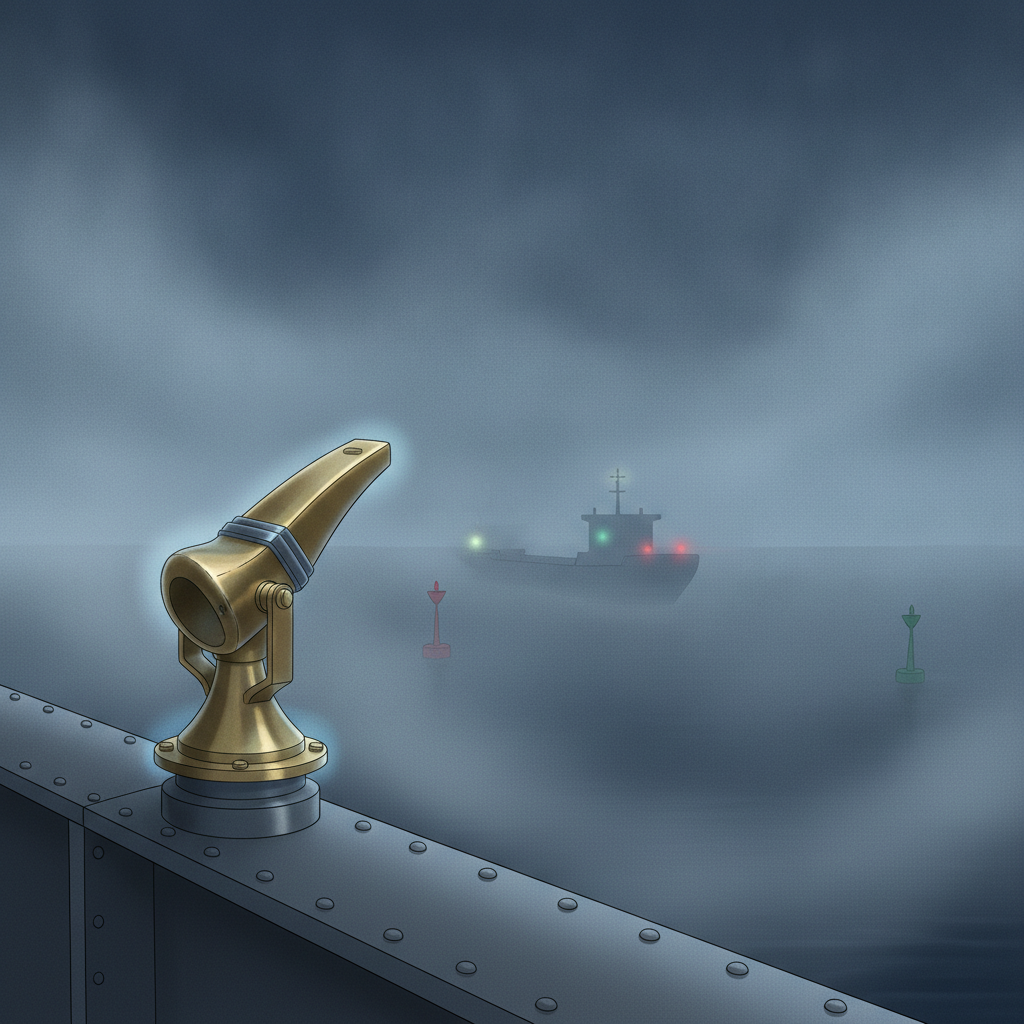
A single short blast on the whistle seems simple enough until you realise it means something different depending on whether you are on the high seas or navigating a US river. Sound signals are one of those areas where candidates lose marks not through ignorance of the rules but through confusion between two parallel systems that overlap in frustrating ways. Get this right and you will be better prepared both for examinations and for the real situations that make these rules matter.
The COLREGS divide sound signals into two broad families: manoeuvring and warning signals under Rule 34, which apply when vessels are in sight of one another, and restricted-visibility signals under Rule 35, which apply when visibility is reduced regardless of whether another vessel is actually in sight. Understanding which family a signal belongs to is the first step to avoiding the mistakes that examiners and real collision cases expose.
This article is educational support for exam candidates and working skippers. It does not replace formal training, an approved course, or the official publications - the COLREGS text and, for US waters, the USCG Navigation Rules and Regulations Handbook. Always consult the authoritative sources before passage.
Manoeuvring and Warning Signals: Rule 34
Rule 34 governs what you sound when you are taking action in sight of another vessel. Under International COLREGS the signals are action statements: they tell another vessel what your helm is doing at that moment.
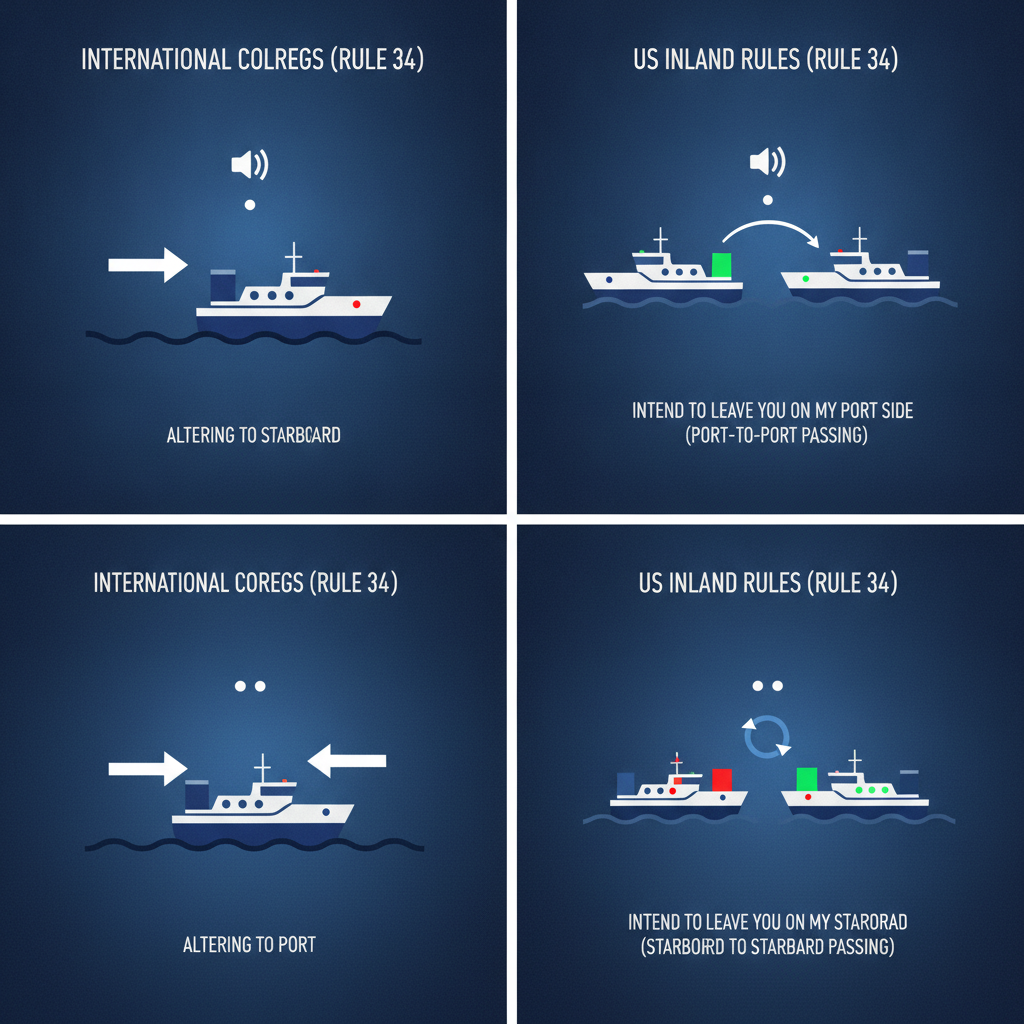
- One short blast - I am altering course to starboard.
- Two short blasts - I am altering course to port.
- Three short blasts - I am operating astern propulsion.
A short blast lasts approximately one second. These three signals are unambiguous under International rules: they describe what the vessel is physically doing, not what it intends to do. A vessel that alters to starboard without sounding one short blast in a situation requiring a signal is in breach of Rule 34.
Five or more short blasts form the doubt or danger signal, sometimes called the "in doubt" signal. Rule 34 requires any vessel that is uncertain whether sufficient action is being taken by another vessel to avoid collision to sound this signal. Five short blasts in quick succession is not an insult; it is a formal indication of doubt, and if you hear it directed at you, treat it seriously and reassess immediately.
Where US Inland Rules Diverge
Here is where many candidates from North America - or anyone preparing for the USCG exams - need to pay close attention. Under US Inland Rules (Inland Rule 34), one and two short blasts carry a fundamentally different meaning.
In Inland waters, one short blast means "I intend to leave you on my port side" - in other words, a proposal for a port-to-port passing, where each vessel passes down the other's port side. Two short blasts means "I intend to leave you on my starboard side" - a proposal for a starboard-to-starboard passing. These are intent signals, not action signals. Crucially, Inland Rule 34 requires the other vessel to respond with the same signal if it agrees, or five short blasts if it does not. This exchange forms the proposal-and-agreement framework, and nothing equivalent exists under International COLREGS.
The practical consequence is significant. A vessel operating under International rules hears one blast and knows the other ship is turning to starboard right now. A vessel operating under Inland rules hears one blast and understands a proposal has been made - it must answer before either vessel commits to the manoeuvre. Mixing these interpretations up in a narrow channel encounter could be dangerous. When you cross between jurisdictions, the rules you apply change at the boundary.
For a structured way to test yourself on exactly these distinctions, the IRPCS practice quiz includes scenario-based questions that place you in both International and Inland situations.
Restricted-Visibility Signals: Rule 35
Rule 35 covers fog signals - those signals made in or near an area of restricted visibility. The critical point is that these signals are not manoeuvring signals. They are positional broadcasts. You are not telling another vessel what you are doing with your helm; you are announcing your presence, your status, and broadly your situation.
The most important Rule 35 signals to know are:
- Power-driven vessel making way - one prolonged blast at intervals of not more than two minutes.
- Power-driven vessel underway but stopped and making no way through the water - two prolonged blasts in succession, with an interval of about two seconds between them, at intervals of not more than two minutes.
- Vessel not under command, vessel restricted in ability to manoeuvre, vessel constrained by her draught, sailing vessel, vessel engaged in fishing, and vessel towing or pushing - one prolonged blast followed by two short blasts in succession, repeated at intervals of not more than two minutes.
- A vessel being towed (or, if more than one vessel is towed, the last vessel of the tow if manned) - one prolonged blast followed by three short blasts in succession, at the same intervals.
A prolonged blast lasts between four and six seconds. Knowing the difference between a short blast and a prolonged blast is not a trivial detail - it is the primary way these signals are distinguished from one another in restricted visibility.
Rule 35 also includes provisions for anchored vessels, vessels aground, and pilot vessels. An anchored vessel rings a bell rapidly for about five seconds at intervals of not more than one minute. In a vessel 100 metres or more in length, a gong is also sounded in the after part of the vessel immediately after the bell signal. These are easy marks to pick up in an exam and easy signals to miss in practice during a sudden fog.
One subtlety worth noting: the fog signal for a vessel not under command, restricted in ability to manoeuvre, constrained by her draught, sailing, fishing, or towing is the same signal - one prolonged and two short blasts. Rule 35 groups these categories together because in restricted visibility the practical priority for an approaching vessel is simply to know that the other vessel has limited manoeuvring freedom, regardless of the specific reason.
Putting It Together: Which Signal, When?
The most common error is sounding a Rule 35 fog signal when Rule 34 applies, or vice versa. Ask yourself two questions before reaching for the whistle:
- Can I see the other vessel? If yes, and action is being taken, Rule 34 applies.
- Is visibility restricted? If yes, Rule 35 signals must be maintained continuously regardless of what Rule 34 requires.
Both can apply simultaneously. If you are in fog and you sight a vessel close ahead and take action, you may need to sound both a fog signal on schedule and a manoeuvring signal for the alteration. In practice, the proximity and urgency of the close-quarters situation may mean the manoeuvring signal takes immediate priority, but the fog signal obligation does not disappear.
You will find detailed rule-by-rule breakdowns in the IRPCS rule library, which is worth working through if any of the categories above feel uncertain.
FAQ
Does three short blasts always mean a vessel is going astern? Under International COLREGS, three short blasts means astern propulsion is being used - not simply that the vessel is moving astern. A vessel can have sternway on without sounding three blasts if it has stopped its engines. The signal describes the machinery action, not the direction of movement. This distinction catches candidates out regularly.
If I hear five short blasts, do I have to respond? The five-blast doubt or danger signal under Rule 34 is a formal warning that the sounding vessel is unsure whether sufficient action is being taken to avoid collision. There is no explicit requirement in Rule 34 to respond with a specific signal, but the clear intent is that you should take immediate action to assess the situation and, if necessary, slow down or take avoiding action. In practical terms, if five blasts appear to be directed at you, slowing and reassessing is always the right instinct.
Do fog signals apply to small leisure craft? Yes. Rule 35 applies to all vessels. A small sailing yacht in restricted visibility is required to sound the appropriate signal at the correct intervals. If the vessel cannot produce a signal that meets the equipment requirements, Rule 35 still obliges it to make an efficient sound signal by some means at the prescribed intervals. Leisure skippers who assume fog signals are only for ships are mistaken and potentially in breach of the rules.
Why do International and US Inland rules use such similar signals for different purposes? The Inland Rules evolved from a separate domestic tradition before the International COLREGS were consolidated in 1972. The proposal-and-agreement system for Inland waters reflects a river and harbour piloting culture where close-quarters manoeuvres in confined channels required explicit mutual agreement before action. Rather than replacing that system entirely, US Inland Rules preserved it. The result is a genuine source of confusion at jurisdictional boundaries, which is why knowing which set of rules applies at any given moment is itself a navigational responsibility.
Drill it until it's instinct.
The IRPCS app turns every rule on this blog into adaptive quizzes, drills, and mock exams - free to start.