Rule 15 Crossing Situations: Who Gives Way and Why
Rule 15 governs crossing situations at sea. Learn who gives way, what constant bearing means in practice, and why you must never cross ahead of the stand-on vessel.
13 July 2026 · 8 min read · IRPCS crew
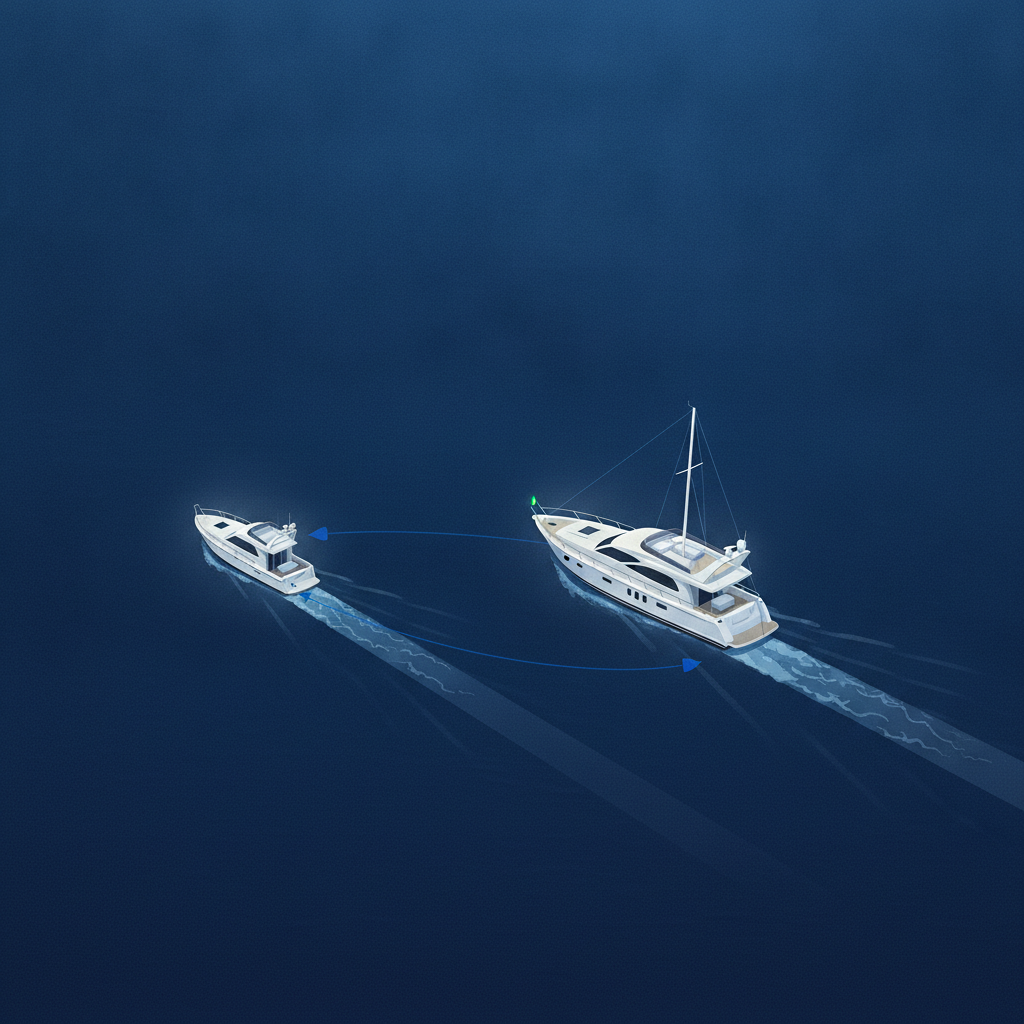
Of all the encounter types a skipper faces, the crossing situation is perhaps the most misread and most litigated. Two vessels converge, both are under power, neither is overtaking, and suddenly the question of who does what, and when, becomes genuinely urgent. Rule 15 exists precisely to answer that question, and understanding it properly means going beyond a simple left-right memory trick.
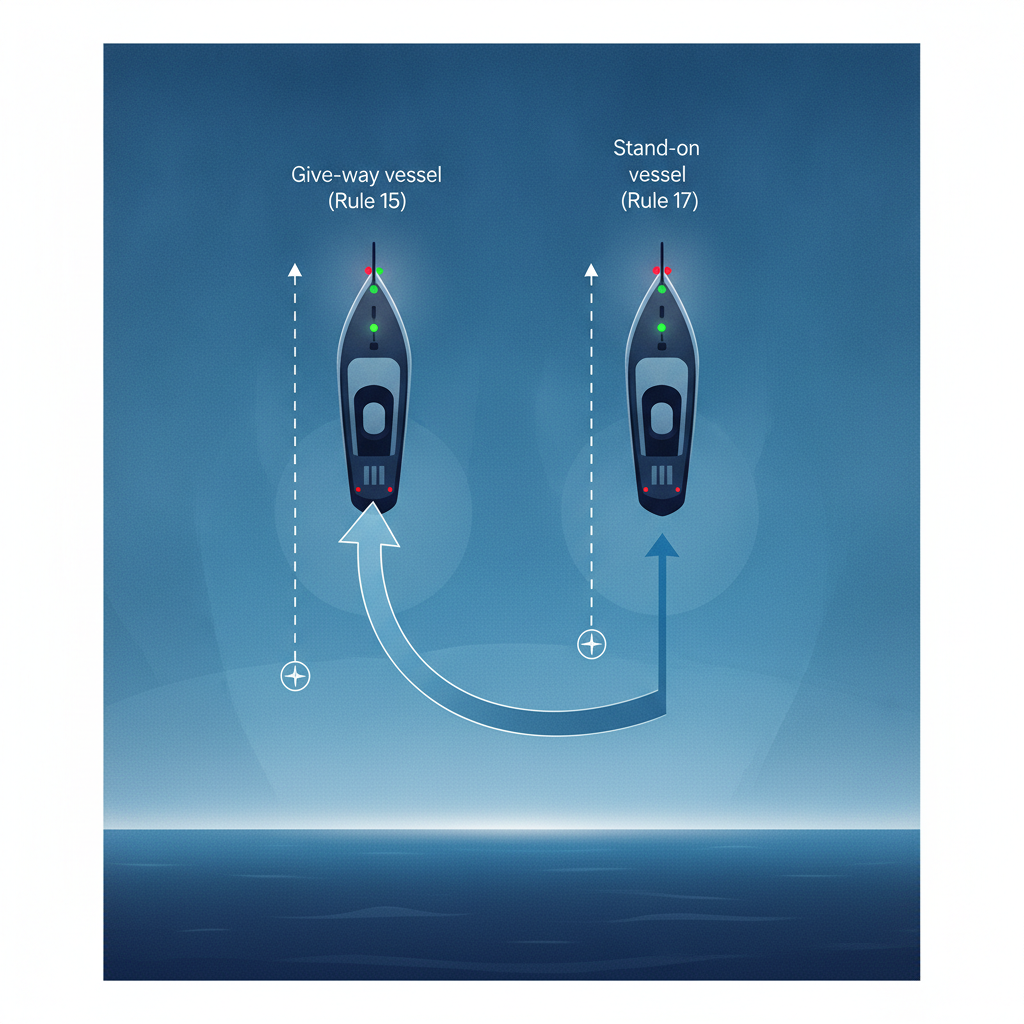
The core principle is elegant: when two power-driven vessels are crossing so as to involve risk of collision, the vessel that has the other on her own starboard side must keep out of the way. That vessel (the give-way vessel) must, under Rule 16, take early and substantial action. The other vessel (the stand-on vessel) must, under Rule 17, maintain her course and speed, at least initially. Getting comfortable with those two companion rules is just as important as knowing Rule 15 itself, and the IRPCS rule library at /#learn covers all three in detail.
Note that Rule 15 applies only to power-driven vessels. A sailing vessel is governed by Rules 12 and 18, not Rule 15, so the crossing-to-starboard logic does not apply in the same way when sail is involved.
The Geometry: Picturing the Crossing Situation
Draw the scene in your head. Your vessel is heading north. Another power-driven vessel is heading east, crossing your path from left to right. She is on your port bow. Because she has you on her starboard side, she is the give-way vessel under Rule 15. You are the stand-on vessel and Rule 17 tells you to hold your course and speed while she manoeuvres clear.
Now flip it. You are heading north, and the other vessel is heading west, crossing from right to left. She sits on your starboard bow. You have her on your starboard side, which means you are the give-way vessel. You must keep clear of her. The fact that she appears to be crossing in front of you does not change the obligation - what matters is which side of your vessel she is on.
The boundary between these two scenarios (the line down your centreline from bow to stern) is where much of the confusion lives. Vessels fine on either bow can drift across that line as angles change, which is why you must not assess a crossing situation once and then stop thinking.
Constant Bearing, Decreasing Range: The Real Warning Sign
A constant bearing with decreasing range is the definitive indicator that a collision will occur if neither vessel acts. It is not a rough guide or a rule of thumb - it is geometry. If the compass bearing to another vessel does not change while the distance between you is closing, your paths will intersect at the same point at the same time.
In practice, watch the other vessel against a fixed point on your superstructure, or take repeated hand-bearing compass readings. If the bearing holds steady and the vessel is clearly getting closer, you have a developing collision situation and Rule 8 requires action that is large enough to be readily apparent to the other vessel. Small, hesitant alterations are worse than useless - they create confusion without creating sea room.
A slowly drawing bearing (one that is gradually changing forward or aft) is less immediately alarming but still needs monitoring. A bearing that is drawing aft means you will pass ahead of the other vessel; one drawing forward means she will cross ahead of you. Even a slowly drawing bearing can firm up into a constant bearing if speeds change, so never stop watching.
Why You Must Not Cross Ahead
Rule 15 does not specify exactly how the give-way vessel must keep clear. Rule 16 says the action must be large enough to be effective, and good seamanship fills in the rest. But there is one manoeuvre that experienced mariners and courts have consistently condemned: altering course to cross ahead of the stand-on vessel.
Think about why. The stand-on vessel is required by Rule 17 to maintain course and speed. If the give-way vessel turns to cross ahead, she is cutting across the path of a vessel that has every right (and a legal duty) to stay put. Any miscalculation of speed, distance, or timing leaves no margin. If the give-way vessel is slightly slower than she thought, or the stand-on vessel is slightly faster, the two vessels arrive at the same point simultaneously.
The seamanlike option for a give-way vessel in a crossing situation is almost always to slow down, stop, or alter course to pass astern of the stand-on vessel. Passing astern is predictable, clearly signals your intentions, and gives you control over the outcome. It also removes the need for the stand-on vessel to take any action at all, which keeps the encounter clean and reduces the risk of two vessels manoeuvring simultaneously in opposite directions.
For exam candidates, it is worth knowing that the instruction to avoid crossing ahead is not written into Rule 15 verbatim, but Rule 8 requires collision-avoidance action to be positive and effective, and the principle of passing astern is deeply embedded in COLREGS case law and official guidance.
When the Stand-On Vessel Must Act
Rule 17 gives the stand-on vessel an important permission and an eventual duty. Initially she must hold course and speed. But if it becomes apparent that the give-way vessel is not taking appropriate action, the stand-on vessel may (and eventually must) take action herself to avoid collision.
That transition from permission to obligation happens when a collision cannot be avoided by the give-way vessel's action alone. At that point, the stand-on vessel is required to act, but she must not alter course to port if the other vessel is on her port side - that would be turning into the problem. Altering to starboard, or slowing, or stopping, are the preferred options.
This provision matters because it prevents Rule 17 from becoming a licence for the stand-on vessel to simply hold on while catastrophe unfolds. Both vessels share a duty to avoid collision under Rule 2, which makes seamanship and good judgement the overarching requirement throughout every encounter. You can test your understanding of how these rules interact with the practice quiz at /#quiz.
Lights and the Crossing Situation at Night
Identifying a crossing situation at night depends entirely on correctly reading the other vessel's navigation lights. A power-driven vessel underway shows a red sidelight on her port side and a green sidelight on her starboard side, plus masthead light or lights and a sternlight.
If you see the other vessel's green (starboard) sidelight, her starboard side is facing you. That means you are somewhere in the arc ahead of her starboard side, which places you on her starboard side. Under Rule 15, she has you on her starboard side, so she is the give-way vessel. You are stand-on.
If you see the other vessel's red (port) sidelight, her port side is facing you. You are in the arc ahead of her port side, which places you on her port side. She is therefore not the give-way vessel under Rule 15. It is you who has her on your starboard side, making you the give-way vessel.
The shorthand many instructors teach is: green means the other vessel gives way (she sees you on her starboard side), red means you give way (you have her on your starboard side). That shorthand is imprecise and should never substitute for a proper analysis of geometry, but it is a useful first alert, especially at night when relative bearings are harder to judge.
FAQ
Does Rule 15 apply if one vessel is a sailing vessel and the other is under power? No. Rule 15 applies only between two power-driven vessels. When a sailing vessel is involved, Rule 18 generally requires the power-driven vessel to keep out of the way of the sailing vessel, with exceptions for vessels restricted in their ability to manoeuvre, vessels constrained by draught, and certain other categories. Rule 12 governs encounters between two sailing vessels.
What if I am uncertain whether the bearing is truly constant? Take repeated hand-bearing compass readings at short intervals. One minute apart is a sensible starting point in a fast-closing situation. If the readings are not clearly drawing forward or aft, treat the situation as a potential collision risk. Rule 7 requires that any doubt about risk of collision be resolved by assuming that risk does exist. Erring on the side of caution is both legally correct and seamanlike.
Can the give-way vessel in a crossing situation simply slow down rather than altering course? Yes. Slowing or stopping is entirely valid under Rule 16, and in some situations it is preferable to a course alteration because it is more easily understood by the stand-on vessel. The key requirement is that the action must be large and early enough to be effective. A marginal reduction in speed that barely changes the time-to-closest-point-of-approach does not meet that standard.
What if both vessels misidentify who is give-way and both hold course? This is exactly the scenario Rule 2 addresses. Beyond the specific rules, every vessel and every skipper retains a residual duty to take all precautions that good seamanship requires. If the situation deteriorates to the point where a collision is imminent and neither vessel has acted correctly, both have failed their obligations. The best protection is early assessment, early action, and a manoeuvre that clearly communicates your intentions.
Drill it until it's instinct.
The IRPCS app turns every rule on this blog into adaptive quizzes, drills, and mock exams - free to start.