Rule 14: Recognising a Head-On and the Starboard Reflex
How to identify a head-on situation at night, why Rule 14's in-doubt clause matters, and why starboard is always the right turn.
6 July 2026 · 9 min read · IRPCS crew
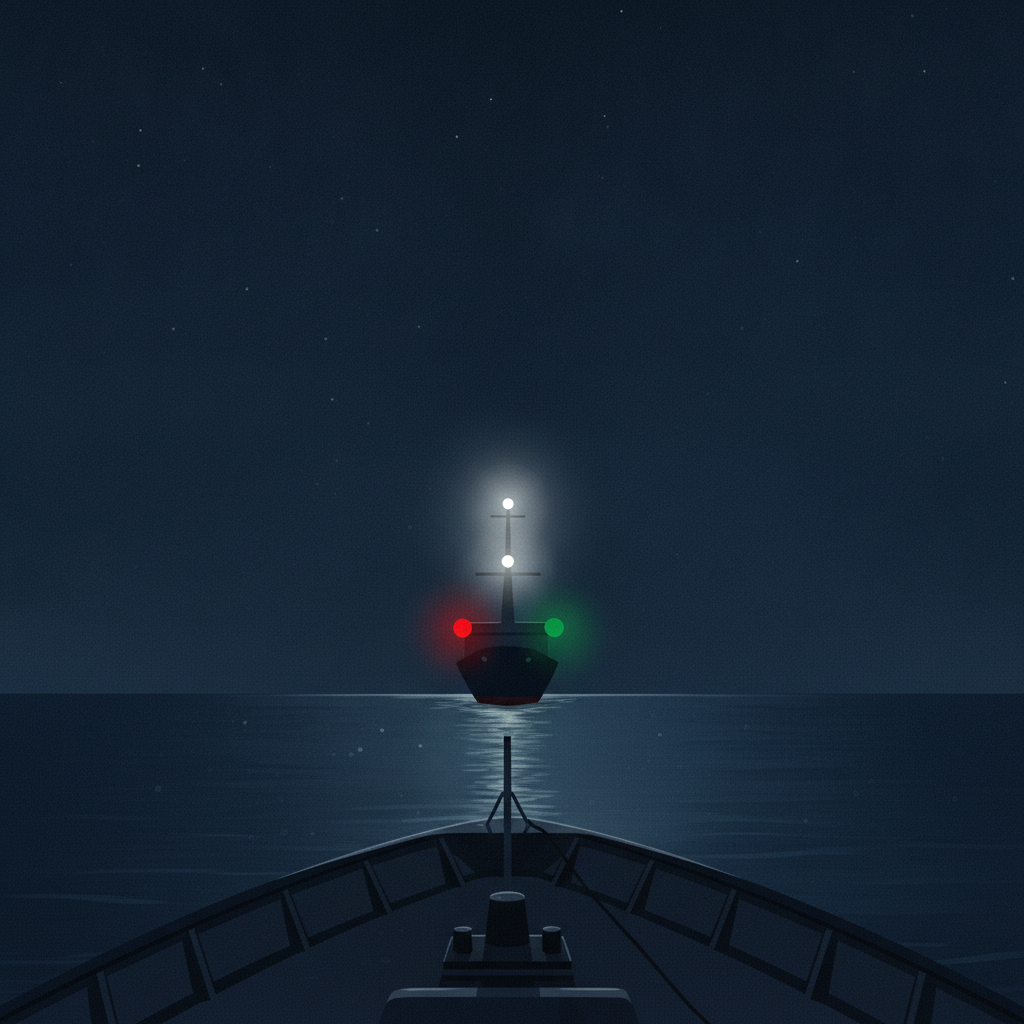
There is a particular kind of unease that comes with watching a white light dead ahead slowly resolve into two sidelights - one red, one green - sitting either side of a pale masthead glow. You are looking at a vessel on a reciprocal course, closing at the combined speed of you both. Rule 14 governs what happens next, and it does so with admirable clarity: both vessels alter to starboard. No negotiation, no radio call to agree who goes which way. Just two ships turning right until they pass port-to-port.
What makes Rule 14 worth studying carefully is not the action itself - most skippers absorb the starboard turn early in their training - but the two subtler elements that sit alongside it. The first is the precise visual picture that tells you a head-on situation actually exists. The second is the rule's own in-doubt provision, which is genuinely unusual in COLREGS: if you are unsure whether the situation is head-on, the rule requires you to assume that it is and act accordingly. Understanding both of those points is what separates a skipper who reacts correctly from one who hesitates at the wrong moment.
What the Rule Actually Requires
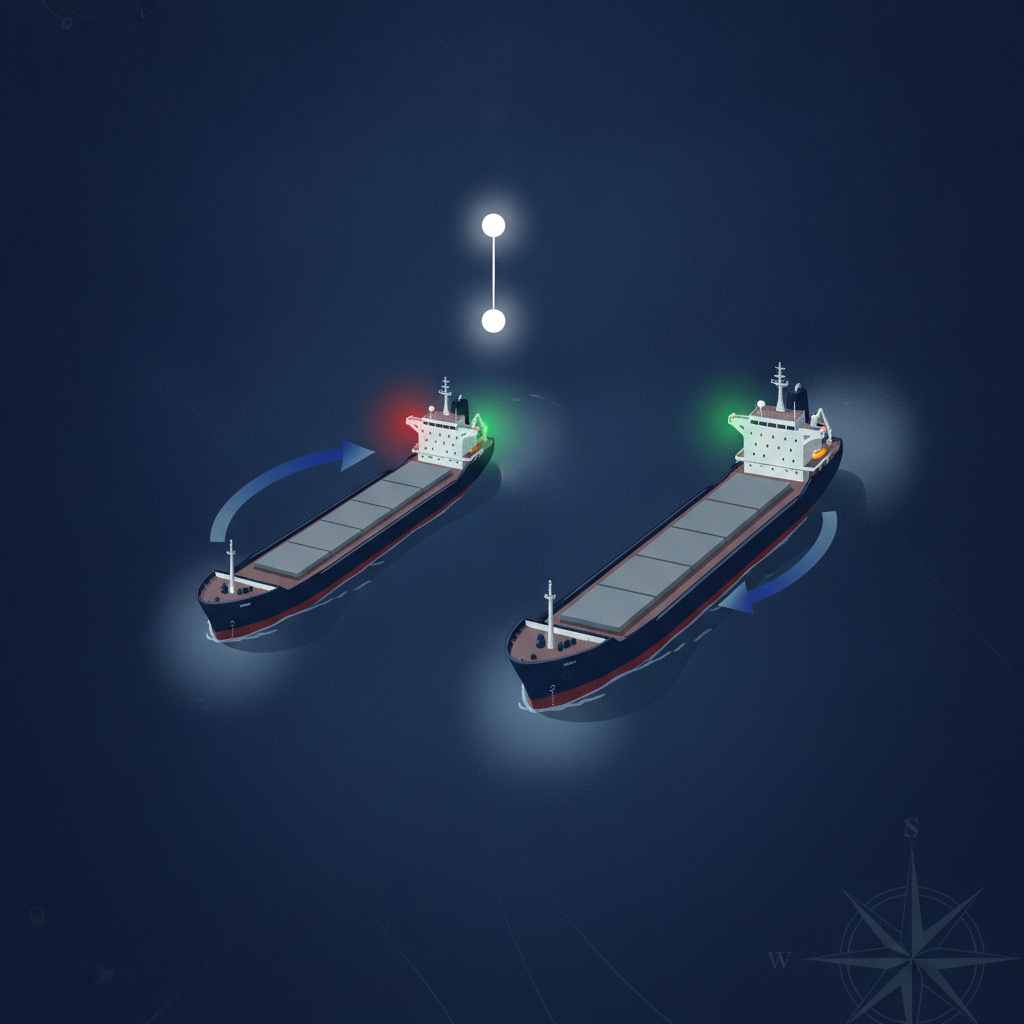
Rule 14 applies when two power-driven vessels are meeting on reciprocal or nearly reciprocal courses such that there is a risk of collision. The prescribed action for both vessels is to alter course to starboard so that each passes on the port side of the other. That obligation falls equally on both - this is not a stand-on and give-way pairing as you find in a crossing situation under Rule 15. Both vessels act, both turn right, and the geometry resolves cleanly.
The rule also addresses the in-doubt case directly. If a vessel is uncertain whether the situation is truly head-on, Rule 14 states that the situation should be assumed to exist and the appropriate action taken. This is a rare instance where COLREGS builds the cautious assumption into the text of the rule itself, rather than leaving it to the mariner's judgement. The practical implication is significant: if the lights ahead are ambiguous - perhaps a small yaw is making one sidelight blink in and out - you do not wait for certainty before turning.
Reading the Night Picture
Recognising a head-on situation at night is a skill that deserves deliberate practice, because the visual cues are specific and the consequences of misreading them are serious.
A vessel on a reciprocal course will show you both sidelights simultaneously. Facing you head-on, its port sidelight - red - is on your left, and its starboard sidelight - green - is on your right. Those two colours flank one or more white masthead lights. On a vessel of 50 metres or more in length there will be two masthead lights, the forward one lower than the after one. Because the after light is higher and both lights sit on the vessel's fore-and-aft centreline, when you are dead ahead you see them one above the other - Rule 14 itself describes this as seeing the masthead lights of the other vessel in a line or nearly in a line. That paired white picture, with red to your left and green to your right, is the clearest possible signal of a head-on.
On smaller vessels with a single masthead light you simply see white above the paired sidelights. The diagnostic question is whether you can see both sidelights at the same time. In a crossing situation you will see only one - either red or green - because the other vessel's aspect means its hull is hiding the far sidelight. Seeing both together, even if they are not perfectly symmetrical due to a gentle yaw, puts you firmly in Rule 14 territory or close enough to it that the in-doubt clause applies.
Bearing is the other tool. A constant compass bearing on a vessel showing both sidelights means collision is certain unless action is taken. A slowly changing bearing where only one sidelight is visible is a strong indicator of a crossing situation under Rule 15; by contrast, if both sidelights remain visible as the bearing shifts slightly, you are most likely still in head-on or near head-on geometry, and the in-doubt provision of Rule 14 continues to apply until the picture is unambiguous.
Why Starboard, and Why Both Vessels
The alter-to-starboard convention is not arbitrary. It mirrors the rule for narrow channels and traffic separation schemes, where keeping to the starboard side of the fairway is the default. The logic runs throughout COLREGS: when in doubt, go right. A vessel turning to starboard in a head-on opens the gap on the port bow, which is exactly where the other vessel is, and swings its own stern away from the risk.
The symmetry of Rule 14 - both vessels acting, neither designated as stand-on - means that in theory both ships turn right simultaneously and the pass is clean. In practice, VHF communication can introduce its own risks here. A call to agree manoeuvres sounds prudent, but it takes time, introduces ambiguity, and can result in one vessel turning to port while the other goes starboard on the assumption that agreement was reached. The COLREGS framework is designed to work without radio negotiation. Turn to starboard early and make it obvious.
Rule 8 requires that any alteration of course taken to avoid collision be large enough to be readily apparent to the other vessel. That principle applies here: a five-degree drift to starboard in a head-on scenario communicates nothing. A substantial, confident turn to starboard, made promptly, gives the other bridge team a clear visual signal that you are manoeuvring and in which direction. If you have a radar-equipped vessel, the target's motion on a relative plot will show the alteration within two or three sweeps.
For candidates working through Rule 14 as part of exam preparation, the rule library at /#learn has structured notes on how Rule 14 relates to Rules 13 and 15 - overtaking and crossing - which are the two situations most likely to be confused with a head-on.
The In-Doubt Clause in Context
It is worth dwelling on the in-doubt provision a moment longer, because it reflects a broader principle in the COLREGS that caution should always lean towards action rather than inaction. Rule 8 already establishes that avoiding action must be taken in ample time. Rule 17 allows the stand-on vessel in a crossing situation to take action when collision cannot be avoided by the give-way vessel alone. And Rule 14 closes off the ambiguity of the head-on recognition problem by declaring that uncertainty itself resolves to action.
For the night watchkeeper who genuinely cannot tell whether a contact is crossing or meeting head-on, this clause is operationally valuable. You do not need to argue the geometry to yourself while the range closes. If there is any realistic chance that this is a head-on and there is risk of collision, you alter to starboard. If it turns out you were on slightly crossing courses, your starboard alteration still moves you clear of the other vessel's path. The geometry is forgiving in that direction; it is considerably less forgiving if you wait.
This is also where plotting or ARPA tracking earns its keep. Even a few minutes of consistent bearing and range data will distinguish a crossing contact from a reciprocal one with high confidence. Good watchkeeping is not about reacting faster; it is about building enough situational awareness early enough that the decisions are easy.
FAQ
How do I distinguish a head-on from a crossing situation using lights alone? In a head-on you will see both sidelights - red and green - at the same time, with the other vessel's red port sidelight appearing on your left and its green starboard sidelight on your right. On a larger vessel you will also see two white masthead lights appearing in a line or nearly in a line, one above the other along the centreline. In a crossing situation you see only one sidelight, because the other vessel's aspect presents only one side to you. If you can see both sidelights together and there is any risk of collision, Rule 14's in-doubt clause means you should treat it as head-on and alter to starboard.
Can I turn to port in a head-on if that seems like the quicker way clear? No. Rule 14 is explicit: both vessels alter to starboard. Turning to port in a head-on increases the risk of collision and directly contradicts the rule. Even if a port turn felt geometrically convenient, the other vessel is also expected to turn to starboard, and a port turn by one of them creates a closing geometry rather than an opening one.
What if I make a VHF call and the other vessel agrees to pass starboard-to-starboard? COLREGS do not prevent communication, but they do not permit radio agreements to override the rules. A starboard-to-starboard pass in a head-on would mean both vessels turning to port, which contradicts Rule 14. The rules exist precisely so that both vessels can act predictably without having to negotiate. If you want to test your understanding of when communication helps and when it creates risk, the practice quiz at /#quiz includes scenario-based questions that explore this kind of judgement.
Does Rule 14 apply to sailing vessels meeting head-on? Rule 14 applies specifically to power-driven vessels. When sailing vessels meet under sail, Rule 12 applies, covering scenarios based on which tack each vessel is on. However, the definition of a power-driven vessel in Rule 3 turns on propulsion by machinery - a sailing vessel is only classified as power-driven when it is actually being propelled by its engine. A vessel that has its engine running for battery charging but is moving solely under sail would not meet that definition; it remains a sailing vessel for the purposes of the rules. Only when the engine is providing propulsion does Rule 14 apply to such a vessel in a meeting situation.
Drill it until it's instinct.
The IRPCS app turns every rule on this blog into adaptive quizzes, drills, and mock exams - free to start.