
Rule 13 Overtaking: The Rule That Overrides All Others
Rule 13 makes every overtaking vessel give-way, full stop. Here's how to identify an overtaking situation, apply the stern-light test, and know when you're finally clear.
15 June 2026 · 8 min read · IRPCS crew
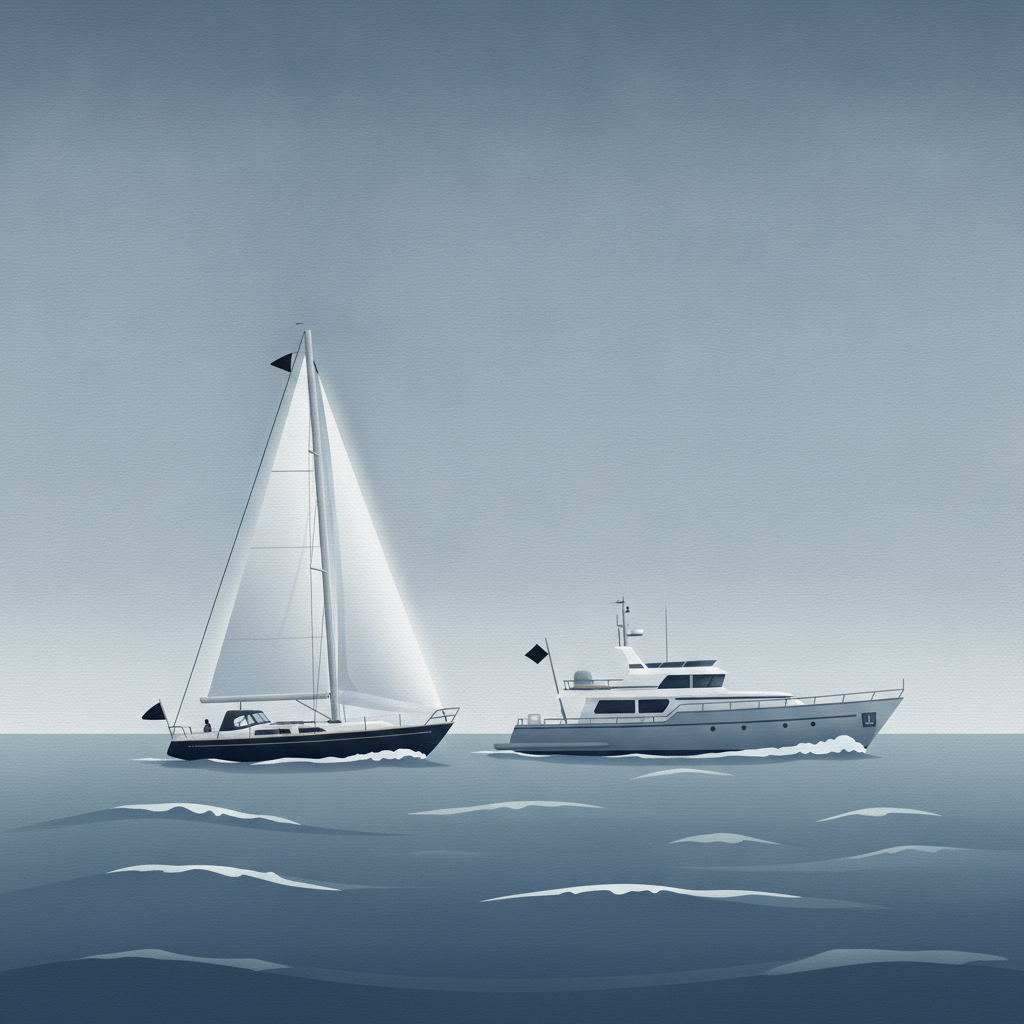
There is a quiet hierarchy inside the COLREGS, and Rule 13 sits near the top of it. When you are overtaking another vessel, it does not matter whether the geometry also looks like a crossing situation or anything else - Rule 13 takes precedence. The rule is blunt and deliberate: the vessel doing the overtaking is always the give-way vessel, and that duty does not evaporate until you are finally past and clear.
For exam candidates and working skippers alike, the tricky part is not what to do once you know you are overtaking - it is knowing whether you are overtaking in the first place. Get that wrong and you may defer to a vessel that is actually required to give way to you, or worse, you both stand on expecting the other to move. Understanding Rule 13 properly starts with the geometry.
What Counts as Overtaking?
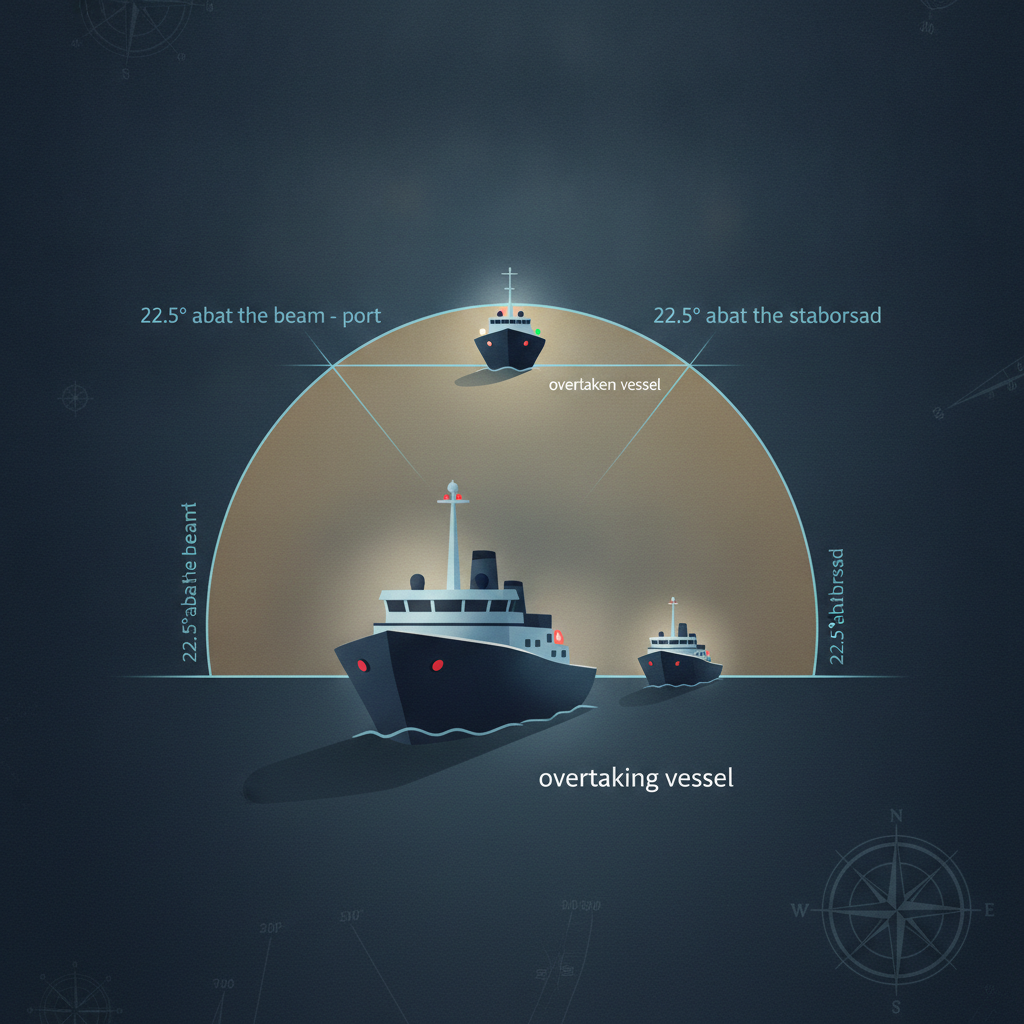
Rule 13 defines an overtaking situation as one vessel coming up on another from a direction more than 22.5 degrees abaft the beam of the vessel ahead. That figure - 22.5 degrees abaft the beam - is not arbitrary. It corresponds exactly to the arc in which the overtaken vessel's stern light is visible: a white light covering 135 degrees, centred on dead astern, extending 67.5 degrees to either side.
In plain terms: if you can see only the stern light of the vessel ahead, Rule 13 applies to you. You are the overtaking vessel and you must keep clear.
The rule is also explicit that any doubt must be resolved in favour of the overtaking assumption. If you are unsure whether you are overtaking or crossing, Rule 13 requires you to act as though you are overtaking. This is a deliberate safety margin - it removes the temptation to reclassify yourself as the stand-on vessel when the geometry feels ambiguous.
The Stern-Light Test at Night
At night, the test is beautifully simple in theory. If the only navigation light you can see from the other vessel is the white stern light, you are overtaking. The moment you can also see a sidelight - green for her starboard side, red for her port - the geometry has changed enough to potentially alter the classification.
In practice, a few complications arise. Vessels in coastal waters are sometimes poorly lit, or older lights may have arcs that bleed slightly outside their designed sectors. Never rely solely on the colour of a light without also tracking the vessel's bearing and assessing your relative motion. A steady bearing with decreasing range is a collision situation regardless of which rule governs it.
During the day the question is answered by visual bearing. Take a careful compass bearing on the vessel ahead and compare it to your own beam. If the other vessel lies more than 22.5 degrees abaft your beam - and you are gaining on her - Rule 13 applies. Bear in mind that the rule is assessed from the overtaken vessel's perspective: it is the arc around her stern that matters, not yours.
Why the Give-Way Duty Persists
One of the most important - and most misunderstood - elements of Rule 13 is how long it lasts. The rule states that an overtaking vessel shall keep out of the way of the vessel being overtaken until she is finally past and clear. Those last four words carry real weight.
Suppose you begin an overtake on a slow-moving coaster, draw level, and then your skipper decides the power is needed elsewhere and you slow back to roughly the same speed. You are no longer overtaking in the kinetic sense, but are you clear? Almost certainly not. You are now running in close company, possibly in the other vessel's blind arc, and the obligation from Rule 13 has not been discharged.
"Finally past and clear" means there is unambiguous separation - you are ahead, the overtaken vessel is well behind, and no further risk of collision from the original overtaking manoeuvre remains. Until that point, the give-way obligation stays with you. There is no halfway house where you quietly reclassify yourself as a crossing vessel because you have drawn level.
This also means that if the overtaking manoeuvre takes you from, say, the port quarter of the vessel ahead to a position where your courses and speeds will eventually produce a crossing geometry, Rule 13 still governs. The COLREGS are clear: a vessel that has taken up an overtaking situation cannot escape that designation mid-manoeuvre simply because the angles have shifted.
For exam purposes - and you can test yourself on exactly this kind of scenario at our practice quiz - it is worth committing to memory that Rule 13 explicitly overrides Rule 15 (crossing). The examiner may present a situation that looks like a crossing scenario from the diagram but where one vessel is, in fact, overtaking. The candidate who applies Rule 13 correctly gets the marks; the one who defaults to crossing rules does not.
The Override Mechanism
The reason Rule 13 overrides Rules 14 and 15 (head-on and crossing) is rooted in the logic of predictability. The COLREGS work best when both vessels in an encounter agree on which rule is governing them. If Rule 13 could be displaced by the crossing rule once you drew level with another vessel, you would have a window of ambiguity mid-manoeuvre where neither vessel was certain of its obligations. The result would be hesitation, conflicting manoeuvres, and danger.
By locking the overtaking vessel into give-way status from the moment the situation begins until it is fully resolved, the rules give the overtaken vessel something genuinely valuable: certainty. She can maintain her course and speed, plan her passage, and trust that the vessel working past her will stay clear. That predictability is what makes a busy shipping lane workable.
It also reinforces the broader philosophy of the COLREGS - that the stand-on vessel should not need to take action unless it becomes clear the give-way vessel is failing to act. Rule 17 gives the stand-on vessel permission to manoeuvre when collision becomes inevitable, but the intent is that it should rarely need to.
You will find the full hierarchy of rules, including how Rules 13, 14, and 15 relate to each other, in the IRPCS rule library, where each rule is broken down with practical commentary.
Summary: Three Things to Remember
When Rule 13 comes up in an exam question or a real encounter, anchor yourself to three points. First, the test is whether you are approaching from more than 22.5 degrees abaft the beam of the vessel ahead - or equivalently, whether you can see her stern light at night. Second, if there is any doubt, you must assume you are overtaking. Third, give-way duty lasts until you are finally past and clear - not just level, not just ahead, but unambiguously separated.
Rule 13 is one of the COLREGS' most elegant pieces of engineering. A single, overriding rule with a clear geometric test, a built-in doubt-resolution mechanism, and an unambiguous end condition. Understanding it thoroughly is not just useful for exams - it is the difference between a confident, safe overtaking manoeuvre and an uncomfortable near-miss in a busy channel.
FAQ
If I am overtaking in a narrow channel, does Rule 9 still apply?
Yes - Rule 9 continues to apply alongside Rule 13, and in a narrow channel its constraints may shape how you conduct the manoeuvre. Rule 9 restricts vessels from impeding the safe passage of vessels that can only navigate within the channel, and overtaking in confined waters needs careful planning. The two rules work together rather than displacing each other.
Can the overtaken vessel help by altering course to make room?
The overtaken vessel is the stand-on vessel under Rule 13 and should initially maintain course and speed. However, both vessels remain subject to Rule 2 (the responsibility rule) and Rule 8 (action to avoid collision), which means neither vessel can act recklessly. In practice, on a VHF-equipped vessel, a brief exchange can assist a safe overtake - but the legal obligation to keep clear rests with the overtaking vessel throughout.
What if I start an overtake and then the other vessel speeds up so I can no longer pass?
Rule 13 does not dissolve simply because the overtake becomes difficult or protracted. You are still the give-way vessel. The correct action is to take early and substantial action - which under Rule 8 may mean abandoning the overtake entirely, dropping back, and creating safe separation astern. Waiting until you are alongside and hoping the other vessel will slow down is not seamanship.
Does Rule 13 apply to sailing vessels overtaking under sail?
Rule 13 applies to all vessels, regardless of means of propulsion. A sailing vessel overtaking a power-driven vessel is the give-way vessel under Rule 13, even though in many other encounter types the power-driven vessel would give way to the sailing vessel. The overtaking rule explicitly overrides the sail-versus-power hierarchy for the duration of the manoeuvre.
Drill it until it's instinct.
The IRPCS app turns every rule on this blog into adaptive quizzes, drills, and mock exams - free to start.