Rule 12 Explained: Which Sailing Vessel Gives Way?
Port tack, starboard tack, windward boat - Rule 12 ranks them all. Here's how to apply the hierarchy confidently at sea and in exams.
10 June 2026 · 9 min read · IRPCS crew
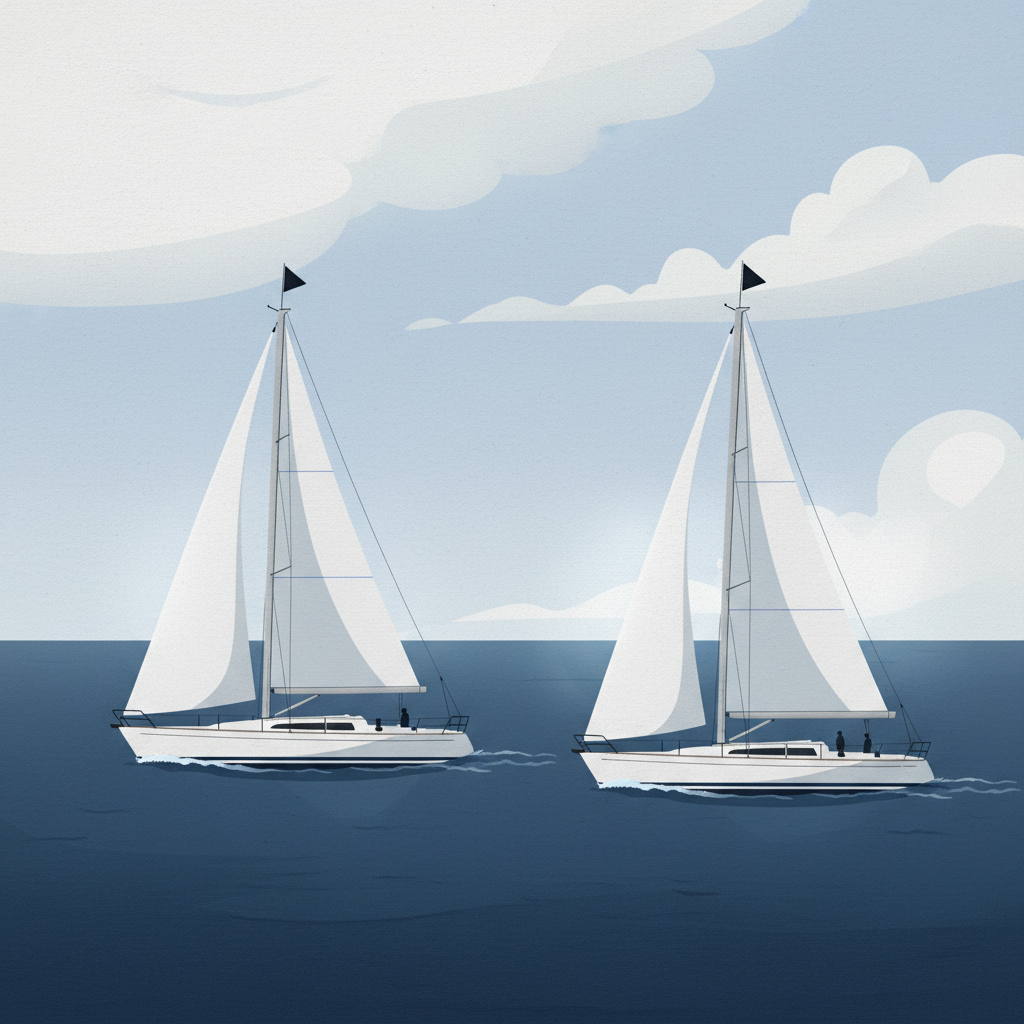
Two sailing vessels converging on a grey afternoon somewhere off the headland. Both skippers glance at each other's rig, read the wind, and make a snap judgement about who moves. Get it right and everyone sails on without a word. Get it wrong and you have, at best, a near miss and a lot of shouting. Rule 12 is the rule that resolves this moment, and it does so with an elegant three-step hierarchy that rewards skippers who understand the reasoning behind it, not just the words.
It is worth remembering that Rule 12 sits within Section II of Part B, which deals with the conduct of vessels in sight of one another. It only applies between two sailing vessels; the moment one of the vessels involved is under power (even partly, in most practical interpretations), you move to the crossing, overtaking, or head-on rules of Rules 13 to 15. With that framing in mind, let's work through the hierarchy in order.
Note: this article is an educational aid for skippers and exam candidates. It does not replace formal training, a qualified examiner, or the official published text of the COLREGS.
Step One: Different Tacks - Port Gives Way to Starboard
The first and most commonly applied test under Rule 12 is whether the two vessels are on opposite tacks. A vessel is on port tack when the wind comes from the port side, meaning the mainsail is carried to starboard. A vessel is on starboard tack when the wind comes from the starboard side and the mainsail lies to port. When the vessels are on different tacks, Rule 12 requires the vessel on port tack to keep out of the way.
This is the rule that racing sailors live and breathe. On a busy start line or a converging approach to a mark, the starboard-tack boat holds her course and the port-tack boat ducks, tacks, or hails early enough to resolve the situation safely. The same logic applies in cruising: a yacht close-hauled on starboard, perhaps making a difficult tidal gate, has every right to hold her course when a port-tack vessel approaches. That does not mean she should be complacent. Rule 17 still limits how the stand-on vessel may manoeuvre once action by the give-way vessel alone is no longer enough.
For exam candidates, the phrase to know is simple: port tack gives way to starboard tack. If that is all you remember, you have covered the majority of sailing vessel encounter scenarios you will ever face.
Step Two: Same Tack - Windward Boat Gives Way
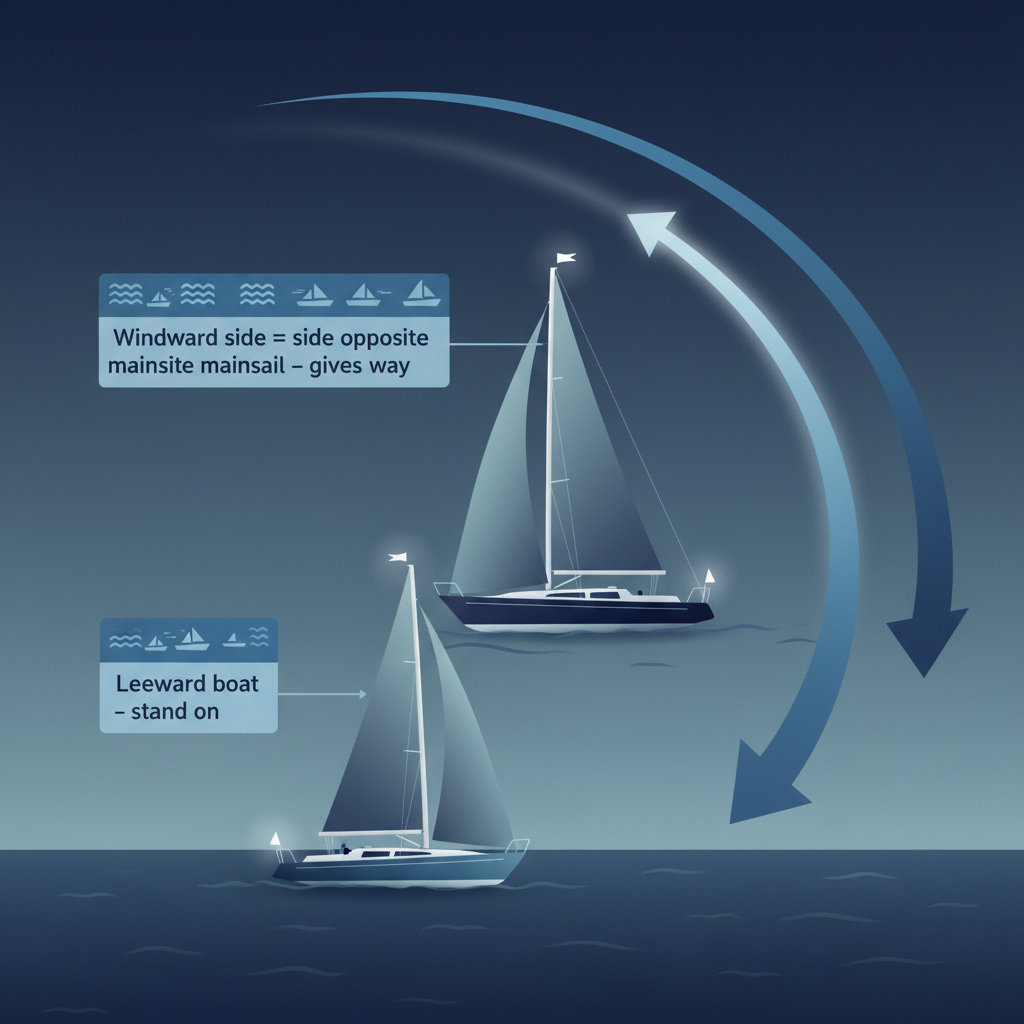
When both vessels are on the same tack, the first test cannot resolve who gives way. Rule 12 then moves to the second test: the windward vessel must keep out of the way of the leeward vessel.
Defining windward precisely matters here, because Rule 12(b) provides a specific definition rather than leaving it to intuition. Under that provision, the windward side is deemed to be the side opposite to that on which the mainsail is carried. In other words, if a vessel is carrying her mainsail to port, her windward side is her starboard side, and she is the windward vessel if the other boat lies on that side. This is the test the COLREGS actually apply, and it is important to work from it rather than from a general sense of which boat is geographically further upwind, since the two can differ in certain configurations.
In straightforward cases the result is intuitive: two yachts on starboard tack, both reaching, with one closer to the wind source than the other. The vessel with her mainsail to port identifies her windward side as starboard. If the other vessel lies on that starboard side, she is the leeward vessel and the stand-on boat. The vessel to windward gives way. The reasoning behind this allocation is worth appreciating: the leeward vessel is often sailing closer to her limits, working to windward or protecting her wind, while the windward vessel has more room to bear away without immediately losing control of her situation.
For racers, this is the overlap principle in open-water context. On a run with two overlapping starboard-tack boats, the windward boat keeps clear. The racing rules and the COLREGS are separate documents with separate authority, but the underlying geometry is the same.
Step Three: The 'Cannot Determine with Certainty' Clause
Here is where Rule 12 becomes genuinely interesting, and where many skippers, even experienced ones, are caught out. Rule 12 contains a provision dealing with the situation where a vessel on port tack sees another sailing vessel to windward and cannot determine with certainty whether that other vessel is on port or starboard tack.
In that situation, the port-tack vessel must keep out of the way.
Think about the scenario this creates. You are on port tack, close-hauled in a building sea. A vessel appears off your windward bow in fading light or across a confused chop. You can see she is sailing and that the wind is coming from the same general direction, but you cannot read her rig clearly enough to know which tack she is on. Rule 12 tells you: if you cannot be certain, and you are on port tack, you give way.
The practical logic is sound. A vessel that cannot determine the other's tack has incomplete situational awareness. Rather than guess, or hold on hoping the picture will clarify, the rule imposes a conservative default on the vessel that would need to give way anyway if the other turned out to be on starboard tack. Uncertainty does not grant privilege; it imposes caution.
This clause is particularly relevant at night or in poor visibility when light combinations on a sailing vessel might be ambiguous. It connects directly to the sound seamanship principle running throughout the COLREGS: when in doubt, act as if the more dangerous scenario is the true one. You can explore the full text and context of all the relevant rules in the IRPCS rule library.
Lights and the Tack Question at Night
Determining tack at night introduces a specific complication. Sailing vessels under Rule 25 may show combined or separate sidelights (red to port, green to starboard) along with a stern light. A sailing vessel of under 20 metres may combine these in a tricolour at the masthead. Neither configuration directly tells you which tack the vessel is on; it tells you where her sides are pointing, which gives you a bearing relationship but not necessarily a tack.
A vessel showing only a red light to you is presenting her port side. If you can also see a white stern light, she is broadly crossing or moving away. But tack? The wind direction relative to her hull is not encoded in the lights. In poor conditions, with an unfamiliar vessel at distance, applying the 'cannot determine with certainty' clause is not just permitted: it is the correct seamanlike response. Combined with Rule 19's requirements when operating in or near restricted visibility, the default to caution becomes even more important.
Putting It Together: A Decision Tree
When you sight another sailing vessel, work through these questions in order:
- Are we on different tacks? If yes, port tack gives way to starboard tack. Done.
- Are we on the same tack? If yes, the vessel whose windward side (the side opposite to that on which her mainsail is carried) faces the other vessel gives way. Done.
- Am I on port tack and uncertain of the other vessel's tack? If yes, I give way.
Notice that starboard tack is never the give-way position in Rule 12 unless the same-tack scenario places the starboard-tack vessel to windward of another starboard-tack vessel. Starboard tack is the dominant position in mixed-tack encounters, full stop.
For cruisers, the takeaway is to make tack identification a habit whenever another sailing vessel comes within range: check the wind direction, look at where the other vessel's boom lies, confirm your own tack, and resolve the hierarchy before the situation becomes urgent. For those preparing for exams, working through timed scenarios is one of the most effective ways to embed the hierarchy. The practice quiz includes a dedicated set of sailing vessel questions drawn from real exam formats.
FAQ
Does Rule 12 apply when a sailing vessel has its engine running? Generally, no. Rule 3(c) defines a sailing vessel as any vessel under sail provided that propelling machinery, if fitted, is not being used. A vessel using its engine, even with sails set, is classified as a power-driven vessel for the purposes of the COLREGS and should be treated under the relevant power-vessel rules. Rule 12 only applies between two vessels that qualify as sailing vessels under that definition.
What if both vessels are on the same tack and it is genuinely unclear which is windward? Rule 12(b) provides the test: the windward side is the side opposite to that on which the mainsail is carried. Apply that definition to each vessel and the windward/leeward relationship should resolve. If the geometry is truly ambiguous in a real encounter, the general collision avoidance obligations under Rule 8 and the good seamanship requirement of Rule 2 apply. In practice, a clearly uncertain situation is a prompt to take early and positive action rather than wait for certainty.
Can the stand-on sailing vessel ever be required to manoeuvre? Yes. Rule 17 allows, and eventually requires, the stand-on vessel to take action when it becomes apparent that the give-way vessel alone is not taking sufficient action to avoid a collision. The stand-on position is not a licence to maintain course into a collision; it is a preference that yields to the overriding obligation under Rule 2 to use good seamanship and observe all precautions required by ordinary practice.
Does the 'cannot determine with certainty' clause only apply to port-tack vessels? Yes, as written in Rule 12. The clause specifically addresses a vessel on port tack that cannot determine the tack of a vessel to windward. It does not create a reciprocal obligation for the windward vessel or for a starboard-tack vessel. The design is asymmetric because port tack is the give-way tack in a mixed encounter: uncertainty confirms rather than suspends that duty.
Drill it until it's instinct.
The IRPCS app turns every rule on this blog into adaptive quizzes, drills, and mock exams - free to start.